Misses Size 8 Slopers you may copy and use

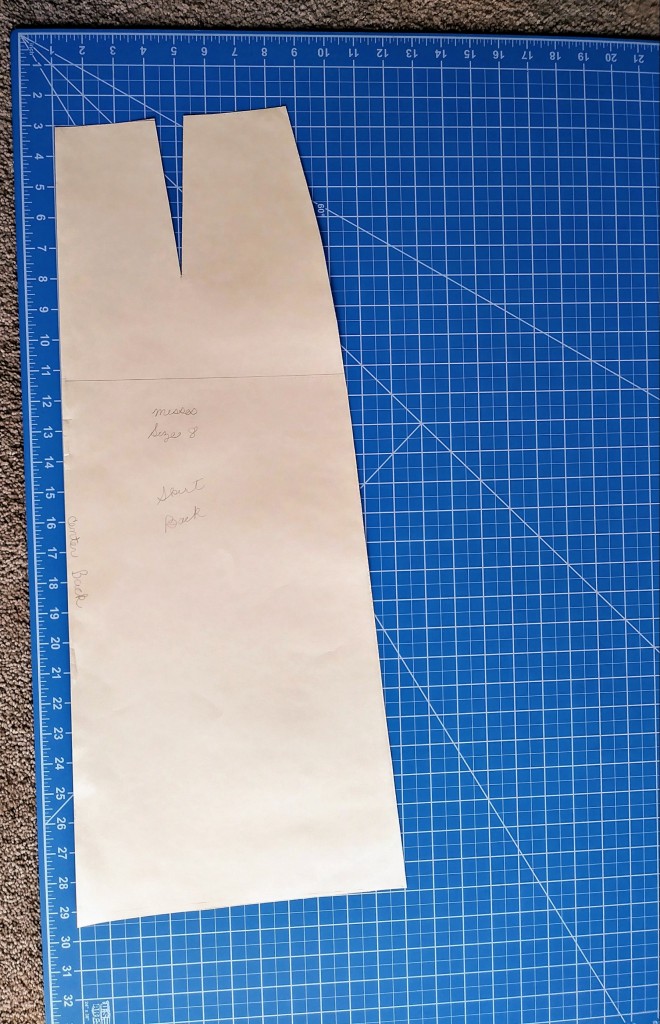
I am releasing my Misses size 8 slopers into the commons. I grant permission to anyone who wants to use them commercially or personally. You can copy, download and size in your graphics program. My reason for making these available is to help others get a head start on their patternmaking and dressmaking business or hobby. The slopers were developed through draping on a Misses size 8 Wolf form. The grid used for the photos is in inches.

Note: The Precision Draping Method developed by Nellie Weymouth Link in 1947 is the system used. There are a few differences in the skirt from the skirt draped in a modern system. The Pencil Skirt which is used today was developed in the 1950s. It is tubular in shape and not given to much flow or movement unless slits or kickpleats are added. The skirt developed with Precision Draping is similar to the skirts you see in the 1940s: slightly A-lined, fitting smoothly over the hip and then flowing past. The result is a slight flare and movement when walking. It is more comfortable and figure flattering, too.

Basic Fitted Bodice Front and Back

Basic Fitted Bodice Front Misses Size 8
Fitted Bodice Back Missies Size 8

Basic Unfitted Sleeve

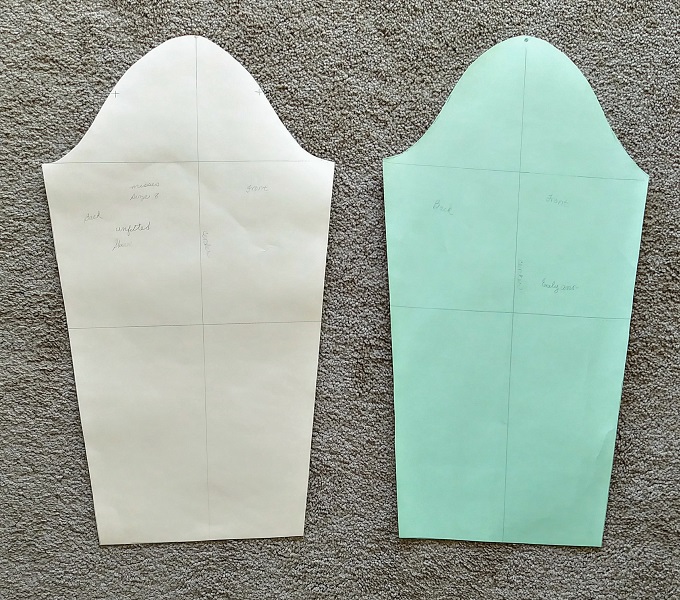
Basic Unfitted Sleeve Misses Size 8

Basic Skirt Front and Back

Basic Skirt Front Misses Size 8
Basic Skirt Back Misses Size 8

New Dress “Alice”: Progress Photos 2-6-21

Introduction

In this posting I share progress photos of a new dress developed through a combo of flat patternmaking and draping. The photos featured are of the half-toile to test the fit.

Combination Technique: Draping and flat patternmaking

95% of this toile was made using a flat pattern. I used the Misses Size 8 sloper to create the fitted bodice, semi-fitted skirt and basic unfitted sleeve.

3/4 view of half-toile.

The flat pattern for the bodice front had the horizontal side dart closed and vertical dart opened. The construction of the bodice shoulder, back yoke, back tuck and side seams were completed. After steam pressing the bodice was pinned to the form. The excess dart intake below the bust was draped into two vertical tucks each 3 1/8″ high and about 1 1/2″ wide. I like the softer look of the tucks over the dressmaker dart under the bust.

Front view of half-toile..

I am very pleased so far with the 6 gore skirt. It was created by closing the darts of the basic semi-fitted skirt. The skirt front and back were cut along the lines of the dart and below the dart. Each piece then had extra width added at the hemline along front and back princess lines and side seams. I find the fit of this kind of gored skirt even more flattering than that of the 6 or 8 gore skirt created through flat patternmaking.

The collar was simple, easy flat patternmaking as was the sleeve. The next posting will be published once the fitting toile is complete.

Giving a Name to the Dress

As I work on a new project and gather the notions and fabric, I develop an image of who the dress will be for. I choose a name to create a sense of space between my self and what is coming to expression. This permits me to think whether or not improvements are needed. When I am too close personally and emotionally to a project become too attached. That is not good because it prevents perception of where the fit or creative result is lacking. This dress is called Alice. I will add a middle name once I feel more of the character of the dress emerging.

Standard Misses 8 and my Altered Customized Sloper

Introduction

The basic fitting shell for the Misses Size 8 was draped. A toile was made twice each time refining the fit. When the basic Size 8 was turned into a sloper I then went on to customize it for myself.

Why not draft a custom made pattern?

I have been drafting patterns to my own measurements and have become very comfortable with the system I use. During the COVID-19 related furlough from my job this past Spring I decided it was time to take on a few challenges.

I am weak in the making of alterations. Since my dress form is a standard Misses 8, I decided to take on the challenges of draping and altering a Misses 8 for myself. I am between a Misses 6 and 8 for the bodice. For a skirt I am between a Misses 8 and 10.

I also have fitting challenges resulting from a small bustline, concave chestline and sloping shoulders. There were a few challenges I wanted to take up on the time I had to stay home from March until June 2020.

Working with Oaktag

The goal of using sloper was on my To Do list since 2018. The large roll of oaktag I bought from Steinlauf & Stoller moved with me from Brooklyn, NY to Linden, NJ waiting to be used. Being tightly rolled up for 2 years made it difficult to get into a workable state for making a sloper.

I had to roll the oaktag out on the floor and keep it in place with heavy books. I then cut the oak tag into length and width suitable to each pattern piece. To stop the curling I pressed each piece of oak tag by covering them with a thick towel. Then I used a steam iron to press flat.

The ends still curled so I laid the pressed oaktag pieces on top of each other onto the floor. The I piled heavy books evenly across them.

After two days the oak tag was flat enough. The pattern pieces were laid on top and the markings transferred. I cut out the darts because I want to try pivoting the pattern pieces to change the dart intake when working on transformations.

Finished Slopers

The white slopers are for the standard Misses Size 8. The green are mine. You can immediately see where my figure differs from the standard. I have to get a hole puncher. Then the hooks from which to hang the sloper pieces.

Bodice and Skirt Slopers. Misses Size 8 left. Size 8 altered to my figure on right.

Misses Size 8 unfitted sleeve on left. Sleeve adjusted to my figure on right.