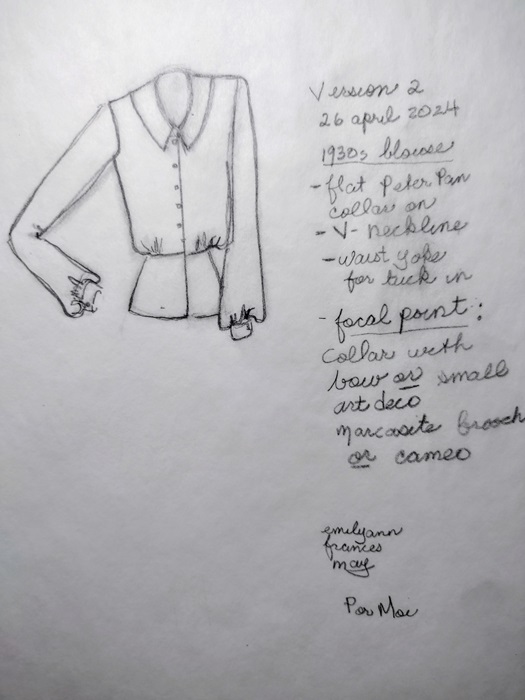
1930s Inspired Skirt and Blouse: Fitting Toile Completed

Introduction

The fitting toile for my 1930s Inspired Skirt and Blouse is finished. I am now thinking of a name for this outfit. I have to research popular women’s names during the 1930s. When I find the one that resonates with this outfit that will be the name I choose. This usually happens after I have completed selecting accessories and lingerie to complete the look.

Please note that the sloper and the pattern are not copies of 1930s patterns or created using a 1930s patternmaking system. I used a modern patternmaking system to save time and because the resulting fit meets the needs of the modern woman for comfort to move and ease in putting on and off.

Details of the Fitting Toile for the 1930s Inspired Skirt and Blouse

One of the difficult details for me in recreating a 1930s inspired blouse was training my eye and mind to accept a wide, flat fitted collar. On the right hand side of the collar in the photo is the narrow collar I started with. I thought this would look better. As I thought about it I realized that I am thinking too much of the narrow Peter Pan collars of 1950s dresses and blouses. I have experience with those, but not with the bolder, wider styled collars of the 1930s.

To attune my eye so that I created the right width I drafted a wider collar and made a toile from that collar pattern. I then pinned it over the left side shown in the photo. I gave myself time to visually accept the comparisons before making a decision. In time I realized the wider collars felt right and looked better for this style of blouse. So with that the wider flat fitted collar was chosen.
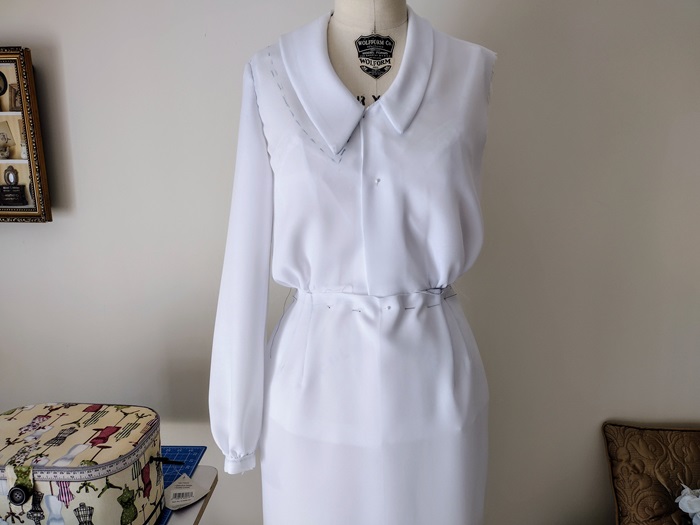
Note: Collar on left is wider than collar on the right. The comparison was made to determine the best width for the overall look of the blouse.

Have you ever noticed how many vintage pattern illustrations from the 1930s and 1940s show blouses with smooth lower portions that look like peplums? Not every blouse with this lower portion that looked like a peplum was indeed a peplum. It was actually a blouse yoke, a feature that is still used in French couture today. The blouse yoke is made from a basic pencil skirt pattern with length equal to distance from waist line to hip line. One or both darts are open to create a very slight flare. The yoke is adjusted during fitting to come a little closer to the hip curve.

The upper portion of the blouse runs from the neckline to waistline. The waist is sewn to the yoke after the bodice side seams are finished. When the skirt is put on, the yoke holds the blouse in place. It also provides a nice fullness and smoothness for the skirt to flow over the hips.
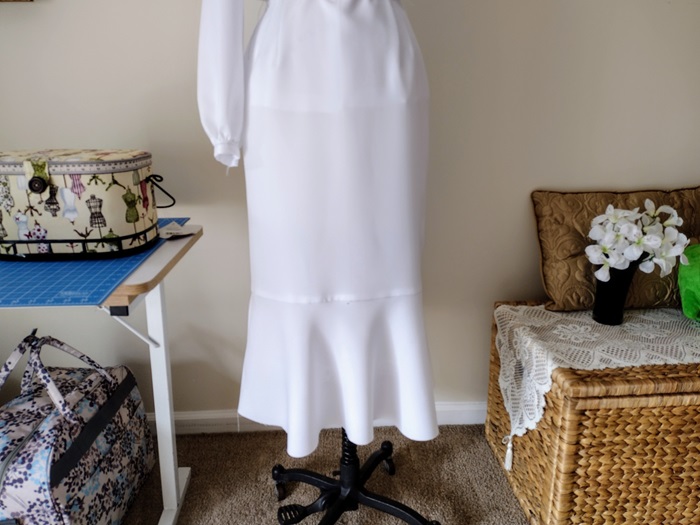
The flounce pattern is derived from cutting a length off the upper skirt pattern. Front and back are evenly divided and opened an equal amount for the slashes. Here is an important tip I learned from trial and error: measure the width of the hem at front and back. They should be equal. Otherwise the flares will look uneven. To get the best and softest flow and movement, cut the flounce at center front placed on the fold of the true bias. This takes more fabric but the result is very beautiful. The flounce can also be cut with center front on the lengthwise grain. There will still be flare but not as much as when cut on true bias.

The skirt will have a 1/2″ to 3/4″ waistband backed with Ban-Rol. This gives a smooth look and fit. The result is that the waistband has an effect similar to a belt. The skirt fits better and the waistband never rolls or bends as it would without interfacing or a non-woven interfacing that is washed or dry cleaned many times.

New pattern: Standard Misses Size 8 Fitting Shell

Introduction

I began work on a new standard size 8 sloper in June 2023. The goal was to achieve a sloper with a more shapely fit that the one I developed for making 1940s style clothing. The technique I used for the 1940s inspired sloper was based on Precision Draping by Nellie Weymouth Link. It resulted in a well fitting sloper that had a bodice adaptable to the shoulder pads and boxy cuts of the 1940s. The skirt has a slight swing in keeping with the slightly A-line shape of 1940s skirts.

I used draping to create a highly structured bodice more suitable for 1950s styles along with a pencil/sheath style skirt. The only thing I did not like about the 1950s style bodice was that it was too, too structured for me. I created a bodice with a vertical dart above and below the bust. The fit was balanced but I did not care for how pointy and emphasized the apex was.

Some disadvantages to draping a style or a sloper

It can be tricky to add style ease to a design made using a sloper. In draping, too, adding a pinch here and a tuck there will change the fit of the garment once the toile is made and fitted on the person or form.

I have seen videos on YouTube where those demonstrating how to drape a sloper on a Misses 8 recommend that the finished garment be labelled a Misses size 6. I didn’t want to go in that direction so I decided to go back to the flat pattern making method I learned at the French Fashion Academy.

Draping still has many advantages. It is a wonderful learning process. Flat patternmaking offers many advantages, too.

Spending three months practicing draping made me very aware of the kind of silhouette I wanted the new size 8 patterns to have. There would be a basic pattern with fitting details but overall a softer effect. For this reason, I created a fitted bodice with only one vertical dart below the bust. The shoulder dart in the back bodice was eliminated. And the fitted sleeve was drafted and adjusted so that there is much less ease to work into the armhole. For the fitting shell, there is less than 7/8″

Fitting Shell vs. Sloper

A professional dressmakers form has some style ease added into it. A sloper for a Size 8 will result in fashions for that size 8 but it may not have ENOUGH style ease to accommodate a range of body types within that Size 8. This is why I decided to go back to the French Fashion Pattern Drafting System.

In the French Fashion system a Fitting Shell is created after taking body measurements. No ease is added. The flat pattern is drafted and the fitting shell tested. It has to fit the form or person like a second skin. When all is corrected, the fitting shell pattern is a blueprint of the form;s or person’s body.

When a pattern is created for a particular style, design ease is added to some of the body measurements. I have found that adding 3″ each to Chest, Bust, and Hips; 3″ to upper arm circumference; 1-2″ to wrist circumference; and 1-1 1/2 inches to waist circumference produces comfortable garments with a good fit. Other garments like coats and suit jackets may need more ease.

This means every style has to have the basic patterns drafted with the style ease added in. It is more work but the results are much more accurate for me. In 2024 I begin drafting and making designs using the patterns based on the measurements used to create the fitting shell.

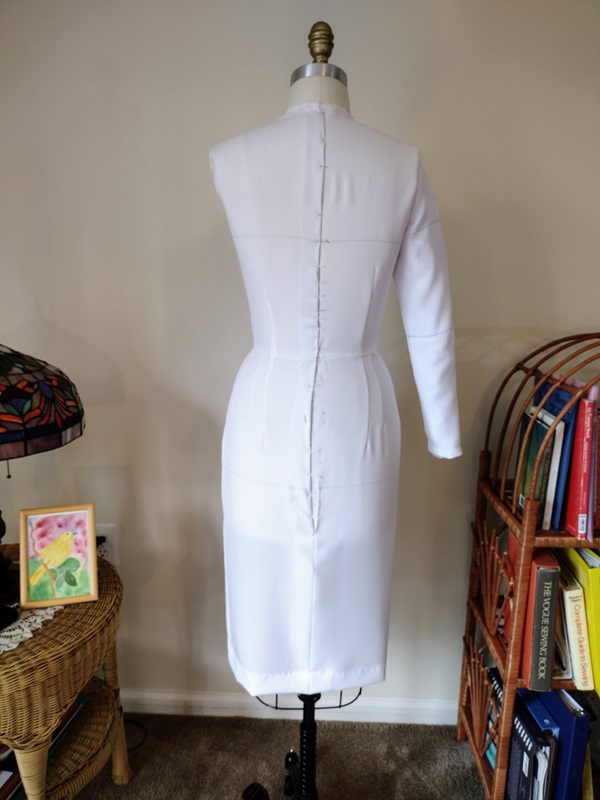
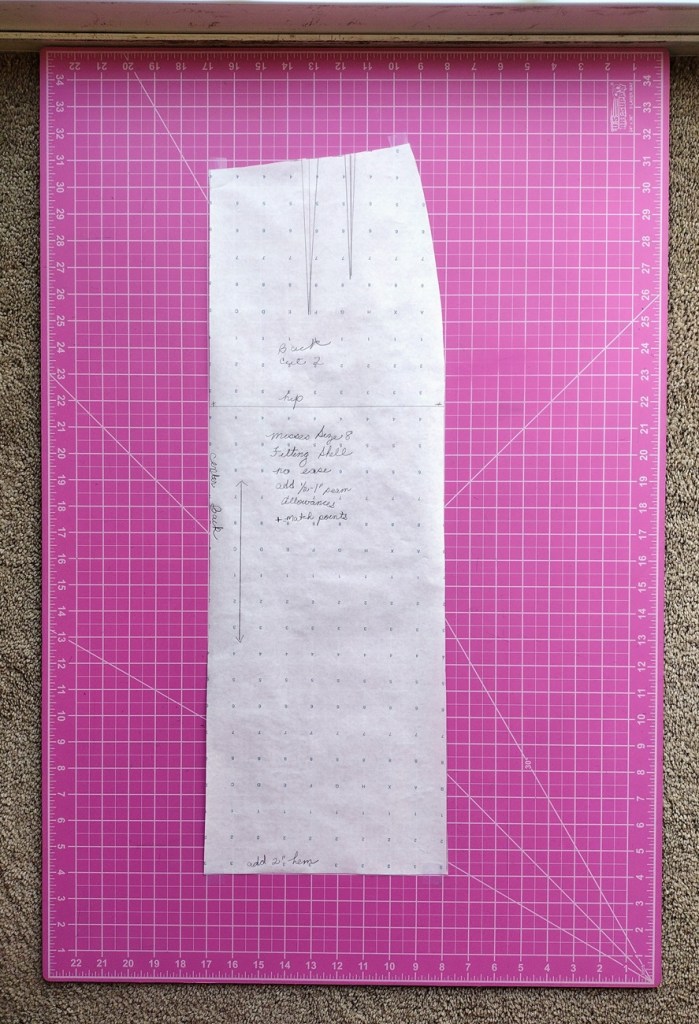
I offer these photos of the fitting shell for copying. You may reproduce and grade the pattern for your own use. Please test each time making a muslin toile.

Notes about using the Fitting Shell

This fitting shell was created using the Standard Measurements for Misses Size 8, 

–There is no style ease added.
–You need to add 1/2″ to 1″ seam allowances. Wider seam allowances make it easier to make adjustments if have to let out the seams.
–Match points are marked with a “+”.
–To sew the sleeve: Use a double row of machine stitches all around the cap. When basting the cap to the armhole, match the “+” marks and the dot on the cap to the shoulder seam. Draw up the stitches and distribute ease around the cap then baste to the armhole.
–The skirt length is 25-27″ for typical 1950s fashions. Add a two inch hem for the fitting shell.

Photos of the Misses Size 8 Fitting Shell

Please Note:  a few adjustments were made after these photos were taken.  i did not make another fitting shell because the adjustments are minor.  This was a working version, of the fitting shell which is why you see the pen marks on it.

Misses Size 8 Fitting Shell

I release these photos into the commons. They may be copied, sized in your graphics program, graded and used for whatever purpose you choose.

Standard Misses 8 and my Altered Customized Sloper

Introduction

The basic fitting shell for the Misses Size 8 was draped. A toile was made twice each time refining the fit. When the basic Size 8 was turned into a sloper I then went on to customize it for myself.

Why not draft a custom made pattern?

I have been drafting patterns to my own measurements and have become very comfortable with the system I use. During the COVID-19 related furlough from my job this past Spring I decided it was time to take on a few challenges.

I am weak in the making of alterations. Since my dress form is a standard Misses 8, I decided to take on the challenges of draping and altering a Misses 8 for myself. I am between a Misses 6 and 8 for the bodice. For a skirt I am between a Misses 8 and 10.

I also have fitting challenges resulting from a small bustline, concave chestline and sloping shoulders. There were a few challenges I wanted to take up on the time I had to stay home from March until June 2020.

Working with Oaktag

The goal of using sloper was on my To Do list since 2018. The large roll of oaktag I bought from Steinlauf & Stoller moved with me from Brooklyn, NY to Linden, NJ waiting to be used. Being tightly rolled up for 2 years made it difficult to get into a workable state for making a sloper.

I had to roll the oaktag out on the floor and keep it in place with heavy books. I then cut the oak tag into length and width suitable to each pattern piece. To stop the curling I pressed each piece of oak tag by covering them with a thick towel. Then I used a steam iron to press flat.

The ends still curled so I laid the pressed oaktag pieces on top of each other onto the floor. The I piled heavy books evenly across them.

After two days the oak tag was flat enough. The pattern pieces were laid on top and the markings transferred. I cut out the darts because I want to try pivoting the pattern pieces to change the dart intake when working on transformations.

Finished Slopers

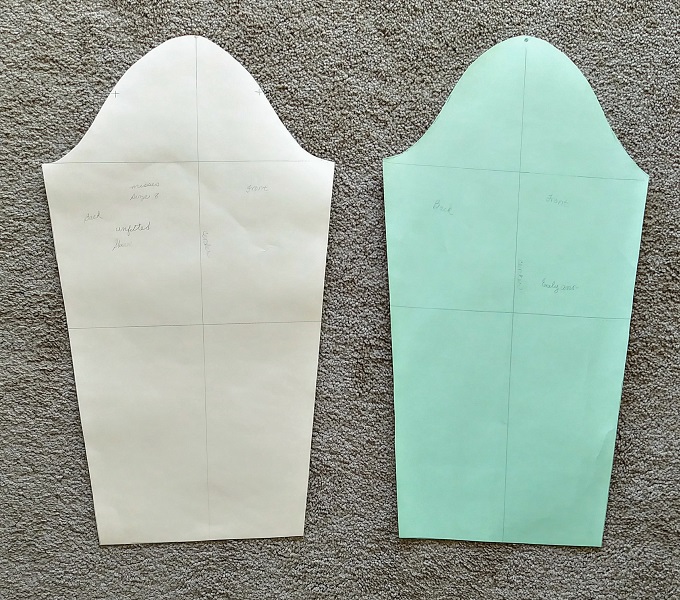
The white slopers are for the standard Misses Size 8. The green are mine. You can immediately see where my figure differs from the standard. I have to get a hole puncher. Then the hooks from which to hang the sloper pieces.

Bodice and Skirt Slopers. Misses Size 8 left. Size 8 altered to my figure on right.

Misses Size 8 unfitted sleeve on left. Sleeve adjusted to my figure on right.

How to Take Measurements

When taking measurements, hold the tape measure with one hand inside, against the body. This will allow a slight amount of ease. The fitting sloper is very close to the body in order to achieve the best assessment of the fit. It also shows if the measurements are accurate or need adjusting. Style ease is added to key measurements once a pattern for a particular style is created. The basic fitting sloper is the mother of all creations. From the basic all your creations will be derived. Some patterns like a half circle or gored skirt do not require so many measurements. These styles are a good start for a pattern drafting.

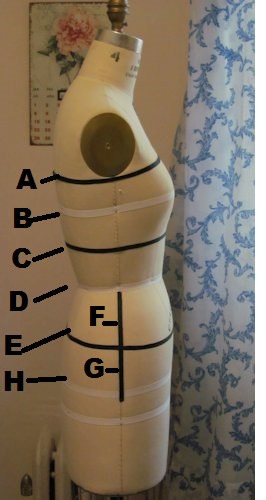
Photo 1
  • CHEST CIRCUMFERENCE: photo 1A
    Place the tape around the back, under the arm and above the bust.
  • BUST CIRCUMFERENCE: photo 1B
    Around the fullest part of the bust.
  • RIB CAGE CIRCUMFERENCE: photo 1C
    About 3-4″ below the bust.
  • WAIST CIRCUMFERENCE: photo 1D
    Around the waist.
  • ABDOMEN CIRCUMFERENCE: photo 1E
    Around the fullest part of the abdomen, approximately 4: below the waist.
  • WAIST TO ABDOMEN: photo 1F
    From the waist to the circumference of the abdomen, usually 4″ to 5″.
  • HIP CIRCUMFERENCE: photo 1G
    Please note a correction: 1G should be same level as 1H. I made a mistake in labelling the photo.
    Around the fullest part of the hip. Note: I have found it varies with figure type. It can be 7 to 9″ below the waistline.
  • WAIST TO HIP: photo 1H
    Measure the distance from waist to hip.
Photo 2
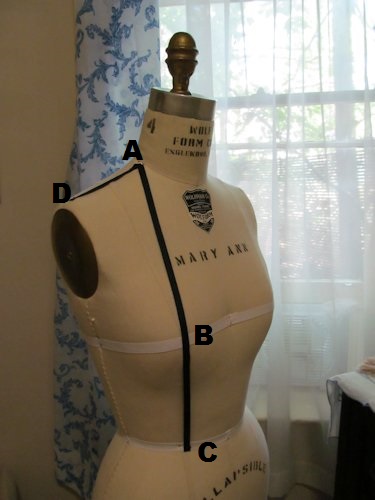
  • SHOULDER WIDTH: photo 2A-D
    From the side of the neck to the tip of the shoulder.
  • NECK TO BUST LENGTH: photo 2A-B
    On the side of the neck from a point where the shoulder begins, to the bust point.
  • FRONT BODICE LENGTH: photo 2A-C
    From the same point as used in the previous measurement, continue with the tape over the bust, adjusting it to the figure down to the waist.
Photo 3
  • NECKLINE: photo 3A-B
    From the first vertebra following the shape of the neck to the place the seam shoulder begins and then to center front.
Photo 4
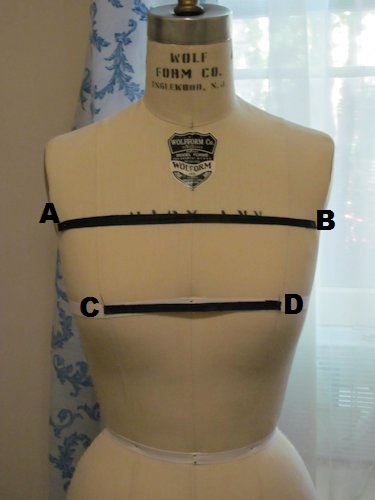
  • CROSS CHEST WIDTH: photo 4A-B
    From the point where the arm begins to the same point on the other arm in the front.
  • BUST SEPARATION: photo 4C-D
    Take the distance between the two breast points.
Photo 5
  • BACK BODICE LENGTH: photo 5A-F
    From the first vertebra down, along the back, to the waistline.
  • CROSS BACK WIDTH: photo 5G-H
    In the back, from the point where the arm begins, to the same point on the other arm.
Photo 6
  • FRONT BODICE LENGTH: 6A-C is the side view of measurement given in 2A-C.
  • FRONT SHOULDER TO WAIST: 6D-E
    From the front edge of the shoulder pull the tape tightly down to the waistline.
  • BACK SHOULDER TO WAIST: 6D-F
    From the back edge of the shoulder pull the tape tightly down to the waistline.
Photo 7
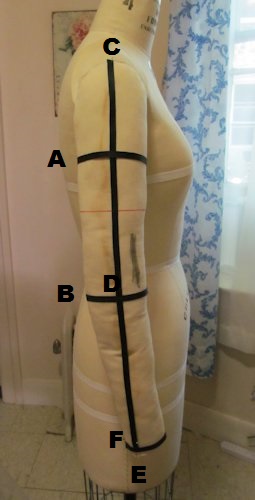
  • Please note that in real life the measurements in this section must be taken with the arm bent so that the hand rests on the hip. This way of measuring the arm provides room for movement.
  • ARM LENGTH: photo 7C-d-E
    From the tip of the shoulder to the wrist.
  • UPPER ARM WIDTH: photo 7A
    Take measurement at widest point of arm. Also called Biceps Level.
  • ELBOW WIDTH: photo 7B
    Around the elbow with arm bent.
  • WRIST WIDTH: photo 7E
    Around the wrist.
Photo 8
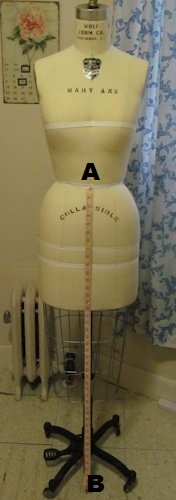
  • FRONT SKIRT LENGTH: photo 8A-B
    Length from waist to floor at Center Front when wearing the kinds of shoes the outfit will be worn with.
Photo 9
  • SIDE SKIRT LENGTH: photo 9C-D
    Length from waist to floor at point where side seam of skirt will be when wearing the kinds of shoes the outfit will be worn with.
Photo 10
  • BACKSKIRT LENGTH: photo 10E-F
    Length from waist to floor at Center Back when wearing the kinds of shoes the outfit will be worn with.