How to draft a Sheath Skirt Sloper

These pattern drafting instructions were given to me by a student who attended the Traphagen School of Design in the 1980s. It was a private design school in New York City. The instructions are very simple when you take the time to read them through before you start drafting your pattern. Make a muslin to test the fit before using this as the basis pattern for any pencil skirts or other designs based on the basic skirt sloper. The basic sheath skirt (a/k/a pencil skirt, slim skirt, wiggle skirt) has not changed. This pattern can serve as a sloper for vintage or modern skirt designs.

Measurements Needed

Center Back Length (from center back waist to desired length of skirt)
Center Front Length (from center front waist to desired length of skirt)
Back waist measure (from side to side seam at back)
Front Waist Measure (from side to side seam at front)
Hip Measurement – 7 to 9 inches below waist-use widest circumference.  Add 2″ of ease to measurement.
Lower Edge of Skirt (this measurement is determined by the hip circumference plus 2″ ease
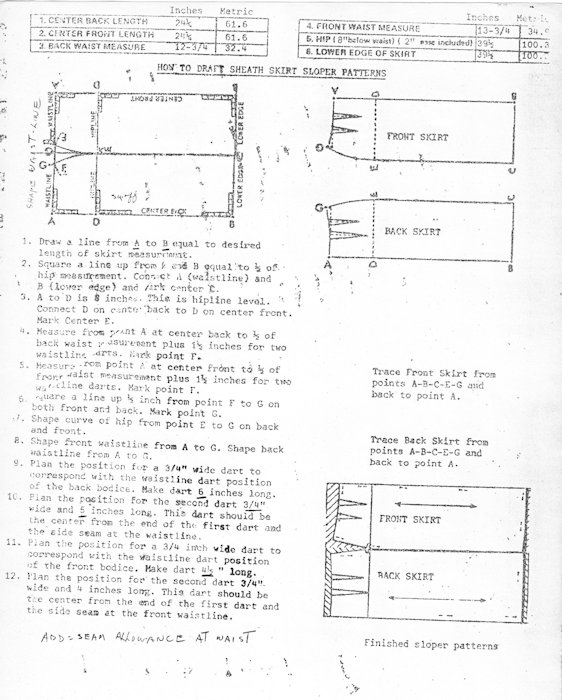
Important Note:  Look at the complete diagram.  The rectangle runs from point A back to point A front at waistline.  Point B back runs to point B front.  Point A to B in the back and Point A to B in the front is the skirt length.  I found it easier to start with a large rectangle where A-A and B-B equals the complete hip measurement plus 2 inches of ease.  So draw A-A for the waist.  The draw A to B for center back.  Draw B to B for lower edge.  Then from B in lower edge of front draw a straight line up to A front.

Then proceed to step 2.

1.   Draw a line from A to B equal to desired length of skirt measurement.

2.   Square a line up from A and B equal to 1/2 ofequal to 1/2 of B (lower edge) and mark center C.

3.   A to D is 7 to 9 inches below waistline.  This is the hipline level.  Connect D on center back to D on center front.  Mark Center E. 

4.   Measure from point A at center back to 1/2 of back wait measurement plus 1 1/2 inches for two waistline darts.  Mark point F.

5.   Measure from point A at center front to 1/2 of front waist measurement plus 1 1/2 inches for two waistline darts.  Mark point F.

6..   Square a line up 1/2 inch from point F to G on both front and back.  Mark point G. 

7.   Shape curve of hip from point E to G on back and front.

8.   Shape front waistline from A to G.  Shape back waistline from A to G.

9.   Plan the position for a 3/4″ wide dart to correspond with the waistline dart position of the back bodice*.  Make dart 6 inches long.

10.   Plan the position for the second dart 3/4″ wide and 5 inches long.  This dart should be the center from the end of the first dart and the side seam at the waistline.

11.   Plan the position for a 3/4 inch wide dart to correspnd with the waistline dart position of the front bodice*.  Make dart 4 1/2″ long.

12.  Plan the position for the second dart 3/4 wide and 4 inches lont.  This dart should be the center from the end of the first dart and the side seam at the front waistline.

13.   Cut out sloper.  This sloper must have 1/2″ seam allowances added at waistline, side seams and center back.  Add hem allowance at bottom of skirt.  The hem for the basic skirt is usually 2″

How to draft a Half Circle Skirt Pattern

Preparation

See “How to Take Measurements” if you are using your personal measurements. You can also use the Standard Misses Size measurements provided here.

You can see the finished half circle skirt here.

Pattern Diagram

Half Circle Skirt pattern diagram.

Measurements Needed

Size Misses 4 measurements are used as an example.

  • Waist=23″
  • Front Skirt Length=24″ (40″-16″=24″)

    Calculate One Fourth of the Waist Measurement:
    1/4 of 23″=5 3/4″
  • Add to the measurement obtained:
    • 1 3/4″ in case of waist measurement from 22 to 26″
    • 2: in the case of waist measurement from 26 to 30″
    • 2 1/4″ in the case of waist measurement from 30 to 34″
    • 2 1/2″ in the case of waist measurement from 34 to 38″

For Misses Size 4 the waist measurement to use is 5 3/4″ + 1 3/4″=7 1/2″

Drafting the Half Circle Skirt Pattern

Make a Right Angle and apply on both sides the result obtained from adding the ease to one fourth of the waist measurement. For Misses size 4 that is 7 1/2″. Refer to pattern illustration. The 7 1/2″ down from the corner are points A-B and A-C.

From B following the A-B line, apply the measurement of the Front Skirt Length. (example, Misses Size 4=24″). Mark the Skirt Length as Point D. Points B-D become Center Front and Center Back of Skirt.

From C following the A-C line, apply in the same manner the measurement of the Front Skirt Length Mark the Skirt Length as Point E. Points C-E are Side Seams of Skirt.

Fold the skirt pattern in half by bring A-B-D over to A-C-E. Crease.

Fold the skirt pattern in another half. Crease.

Open the pattern. The three fold lines represent the rays of the pattern.

From A measure down the A-B distance along the other creases. Mark with a dot. See pattern illustration. Mark each dot F, G, H.

Join points B-F-G-H-C by means of a curve to get the curve of the waistline.

From Points F, G, and H measure down the skirt length along each crease. Mark with a dot. You will mark them I, J, K. Refer to pattern illustration.

Connect D-I-J-K-E for hemline curve.

Cut out the pattern. The grainline can be along B-D when placed on the fold for Center Front and Center Back.

Notes

I advise creating a fitting toile since you may need to adjust the waist at the side seams. Half Circle and Full Circle Skirts cut into the bias. The waistline may stretch a little.

To stabilize the waistline, stay stitch after cutting. Do not hang the skirt up until the waistline is finished with a facing or waistband. Then hang the skirt for 2 days or more so that the drape sets in.

A lapped side zipper is one of my favorite closures. It does not interfere with the drape and the flares.

How to draft a pattern for a gored skirt

Six Gore Skirt Drafting Instructions

Before drafting this skirt pattern please see How to Take Measurements. 

The measurements used in this pattern are for a Misses Size 4.  They are used to provide an example.  You will substitute your own measurements to draft your custom pattern.

The Flattering Qualities of a Gored Skirt

Gored skirts are flattering to all figure types, especially when the pattern is drafted to your own measurements.  This is because the pattern is drafted with a slight curve from waist to abdomen or waist to hipline.  After the slight curve, the line becomes straight and ends however many inches from the center of the skirt that you want.  The greater the width of the hemline the more flare and movement the gores will have.

The point at which the curve stops is best determined by your own hip and abdomen measurements.  In general these are the guidelines:

  • If your hips are larger than your abdomen let the flare start at the hipline.  If this is your body type, then you will use the measurement Waist to Hip line for points A-C.
  • If your abdomen is larger than your hip let the flare start at the abdomen.  In this case you will use the measurement Waist to Abdomen for Point A-C.
  • The Front Skirt Length used is completely up to you.  A length of 27-30” will give you a retro looking skirt reminiscent of the 1930s.  To achieve such an effect use the diagram for creating a Trumpet Skirt with flare starting at the hip line.

Style Ease to add to measurements

For a gored skirt add 1-2” of ease for the abdomen or hipline.  To the waist add about 1/2″ of ease.

Measurements (used for an example) for a Gored Skirt Pattern

Please see posting “How to take Measurements” if you want to use your personal measurements.  To use Standard Size measurements go to my posting with Standard Misses measurements for Sizes 4 through 20.

The measurements used here are for a Standard Size Misses 4.  They are used as an example.  Substitute another Standard Size or your personal measurements. 

  • Waist 24”+ 1/2″ ease=24 ½”
  • Abdomen Circumference 35”+1” ease=36”
    OR
  • Hip Circumference 36”+ 1” ease=37”
  • Waist to Abdomen 4”
    OR
  • Waist to Hip 8”
  • Front Skirt Length 28”

Drafting Instructions for a six gore skirt

You will be dividing the waist, abodomen or hip measurement by six.  If you want to create an 8 gore skirt you will then divide by 8.  If you’re up to it you can also create 10 or 12 gore skirts.  The number of gores you want will determine the number by which the waist and hip or abdomen are divided.

The diagrams show the completed skirt pattern when the pattern is cut and opened.  To draft we will need to draw only half the pattern.

Cut a sheet of pattern paper the front length of the skirt plus 5-6”.  The width should be about 20 inches.

6 gored skirt pattern

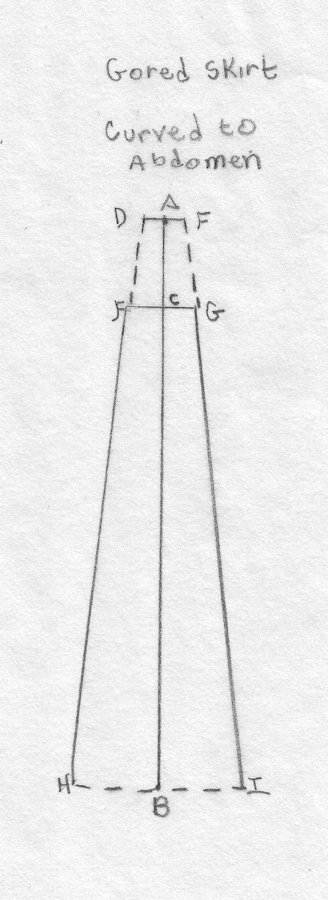
1.   Draw a vertical line equal to the Front Skirt Length.  Label A at the top and B at the bottom. 

2.   Fold the paper along the A-B line.  You will draft with the pattern paper fold on your right hand side and the paper towards your left hand side.

3.   From A mark down the length of Waist to Abdomen or the Waist to Hipline Measurement.  Dot this and mark as point C.

     For a Misses Size 4 skirt with flare from Abdomen Point C is 4” down from A.

     For a Messes Size 4 skirt with flare from Hipline Point C is 8” down from A.

4.   Take the Waist plus ease measurement and divide by the number of gores wanted.  In this sample pattern the Size 4 waist plus ease measurement is 24 1/2″.  So the calculation for a 6 gore skirt is 24 1/2″ divided by 6 equals 4.08”.  Round off to 4”. 

5.   Apply half of the amount derived from the calculation performed in Step 4 and measure out from Point A.  Label Point D.

6.   Take the Abdomen plus ease or Hipline plus ease measurement and divide by the number of gores.  For a trumpet skirt in Misses Size 4 the Hipline measurement will be used.  So the calculation is:

     Hipline plus ease is 37 divided by 6 equals 6.16.  Round off to 6”. 

7.   Apply half of the measurement obtained in Step 6 and draw a straight line from Point C.  Label Point F.

8.   Using the hip curve position the part with the slightest curve against points A and F.  Draw a very slight curve.  It should not be too pronounced of a curve but not a straight line either.

9.   Taking a tape measure, place the start of the tape measure at Point D, continue past Point F and from Point F straight down until the Front Skirt Measurement is reached.  Dot this as point H.

10.   Connect Point B to H with a slight curve. 

Trumpte skirt pattern.

12.   If you want a dramatic flare or are drafting the Trumpet Skirt pattern, measure out from Point H 1” or more.  The greater the amount you measure out the greater the flare will be at the hemline.  I find 1 to 1 1/2″ good enough.  Mark the new Point H and redraw the line from F to the new point H.

     Connect Point B  with the new Point H by a slight curve.

13.   Cut out the pattern and open it up.  The gored piece is now completed.  This represents one gore of the six gore skirt.  You will have to cut 6 pieces.  To make it simpler, fold the pattern piece again and cut two more pattern pieces if you like.

14.   1/2” seam allowances are added when the fabric is cut. 

IMPORTANT:  I strongly advise making a muslin to test the fit and amount of ease.  This will save you so much effort once the fashion fabric is cut.

Grainline for this pattern

The vertical A-B line can be used as the lengthwise grain line.