How to draft a Sheath Skirt Sloper

These pattern drafting instructions were given to me by a student who attended the Traphagen School of Design in the 1980s. It was a private design school in New York City. The instructions are very simple when you take the time to read them through before you start drafting your pattern. Make a muslin to test the fit before using this as the basis pattern for any pencil skirts or other designs based on the basic skirt sloper. The basic sheath skirt (a/k/a pencil skirt, slim skirt, wiggle skirt) has not changed. This pattern can serve as a sloper for vintage or modern skirt designs.

Measurements Needed

Center Back Length (from center back waist to desired length of skirt)
Center Front Length (from center front waist to desired length of skirt)
Back waist measure (from side to side seam at back)
Front Waist Measure (from side to side seam at front)
Hip Measurement – 7 to 9 inches below waist-use widest circumference.  Add 2″ of ease to measurement.
Lower Edge of Skirt (this measurement is determined by the hip circumference plus 2″ ease
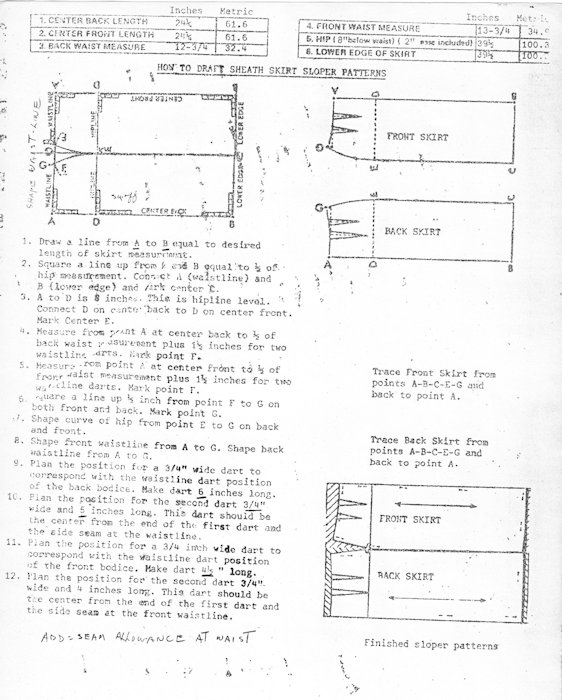
Important Note:  Look at the complete diagram.  The rectangle runs from point A back to point A front at waistline.  Point B back runs to point B front.  Point A to B in the back and Point A to B in the front is the skirt length.  I found it easier to start with a large rectangle where A-A and B-B equals the complete hip measurement plus 2 inches of ease.  So draw A-A for the waist.  The draw A to B for center back.  Draw B to B for lower edge.  Then from B in lower edge of front draw a straight line up to A front.

Then proceed to step 2.

1.   Draw a line from A to B equal to desired length of skirt measurement.

2.   Square a line up from A and B equal to 1/2 ofequal to 1/2 of B (lower edge) and mark center C.

3.   A to D is 7 to 9 inches below waistline.  This is the hipline level.  Connect D on center back to D on center front.  Mark Center E. 

4.   Measure from point A at center back to 1/2 of back wait measurement plus 1 1/2 inches for two waistline darts.  Mark point F.

5.   Measure from point A at center front to 1/2 of front waist measurement plus 1 1/2 inches for two waistline darts.  Mark point F.

6..   Square a line up 1/2 inch from point F to G on both front and back.  Mark point G. 

7.   Shape curve of hip from point E to G on back and front.

8.   Shape front waistline from A to G.  Shape back waistline from A to G.

9.   Plan the position for a 3/4″ wide dart to correspond with the waistline dart position of the back bodice*.  Make dart 6 inches long.

10.   Plan the position for the second dart 3/4″ wide and 5 inches long.  This dart should be the center from the end of the first dart and the side seam at the waistline.

11.   Plan the position for a 3/4 inch wide dart to correspnd with the waistline dart position of the front bodice*.  Make dart 4 1/2″ long.

12.  Plan the position for the second dart 3/4 wide and 4 inches lont.  This dart should be the center from the end of the first dart and the side seam at the front waistline.

13.   Cut out sloper.  This sloper must have 1/2″ seam allowances added at waistline, side seams and center back.  Add hem allowance at bottom of skirt.  The hem for the basic skirt is usually 2″

Alice Elizabeth: My version of a 1950s House Dress by Pat Perkins

Introduction

The dress pattern and design is based on a 1950s house dress by Pat Perkins that I bought during Lockdown 2020. I wanted to create a basic pattern to dervice this and future retro inspired clothes I make. I bought the dress from a vintage seller on Etsy and posted a detailed style analysis . I had plenty of time during lockdown to learn about different vintage draping and patternmaking systems. I chose to teach myself Precision Draping from the book of the same title by Nellie Weymouth Link.

After draping the basic toile on a 2019 Misses Size 8 Wolf Form, I created a sloper on oaktag. I released this sloper into the public domain for anyone to use and improve on. This sloper is the basis of the pattern for the Alice Elizabeth dress.

Dress and Pattern Details

The dress consists of a fitted bodice with two vertical dart tucks on each side of the bodice in front. The skirt is six gores with a very moderate flare at the bottom. The Pat Perkins dress has buttons and loop closure down center front. A metal zipper was sewn into the left seam from 2″ under the arm until the hip line using a lapped application.

I do not like side seam zippers for two reasons. First they can be uncomfortable. Second they interfere with the flow of the underarm seam and skirt side seam. Since fitted clothing often falls on the bias at the side seams the potential for distortion exists. I hand sewed six button holes in the front of the bodice.

My reasons for avoiding buttonholes on the entire dress is that it would spoil the look of simplicity and efficiency the house dress is supposed to convey. I had not thought about using a hidden zipper when the dress was in progress. Now that it is finished I have a hidden zipper in mind for the future. It is a simple application I will detail when it is in progress. I used snaps because the front portion of the skirt looks better. The eye is drawn upwards to focus on the striped buttons and self-fabric belt. I do not care for metal eyelets and prongs in a belt so I used snaps to fasten the belt.

The edge of the front facing, the waistline stay and hem were finished with navy blue Flexi-Lace by Wrights. Seams were pinked. I chose these finishes because they are similar to home based seamstresses used in the 1950s. The Flexi-Lace tape was completely stitched by hand to the waistline seam using a running stitch at the waist and edge for flexibility. I used a cross-hatch stitch to join the stay to side seams and dart tucks.

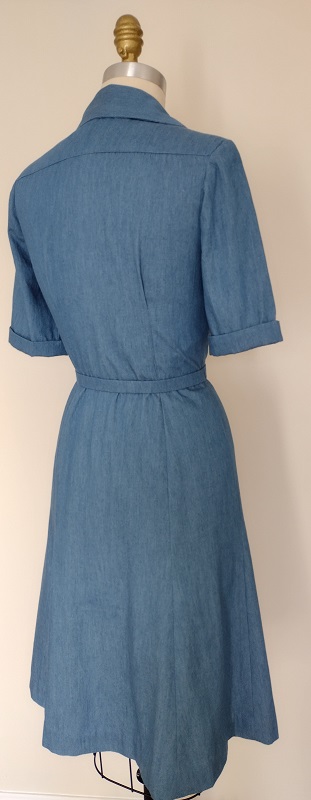
The dress is made from 100% cotton chambray. It is very soft with a good drape. To support the dart tucks more a small edge stitching was used.

A back yoke was used to eliminate the neckline dart on the basic back bodice pattern. That too was edge stitch. On the inside, the yoke is interfaced and lined. The dart tucks in the back are also top stitched.

The collar is a basic collar pattern with a high stand. The undercollar and interfacing are cut on the bias. The sleeves have all-in-one cuffs.

Accessories

I chose understated accessories in sterling silver to keep to the everyday quality I want this outfit to have. The earrings have a pretty filigree. A small silver necklace, about 16″ long, with tiny beads would also look good with this dress.

Ballerina flats in navy blue complete the outfit. They pick up on the color of the stripes on the buttons. The overall impression of this outfit is meant to make the wearer attractive in a modest, understated fashion just as house dresses were intended in the 1950s.