Thanks to the Internet Archive, vintage sewing and fashion enthusiasts can download a PDF version of How to design beautiful clothes, by Esther Pivnick. The book was published in 1949.
The patternmaking system used is the same as what was taught at the Traphagen School of Design in New York City. This book offers a complete guide to taking measurements, creating basic patterns and then transforming them.
Even if you do not use the pattern drafting system, there are details and pattern transformations that can be experimented with using your own sloper. It is well worth it to download a PDF version as the original book sells for over $100 when in good condition.
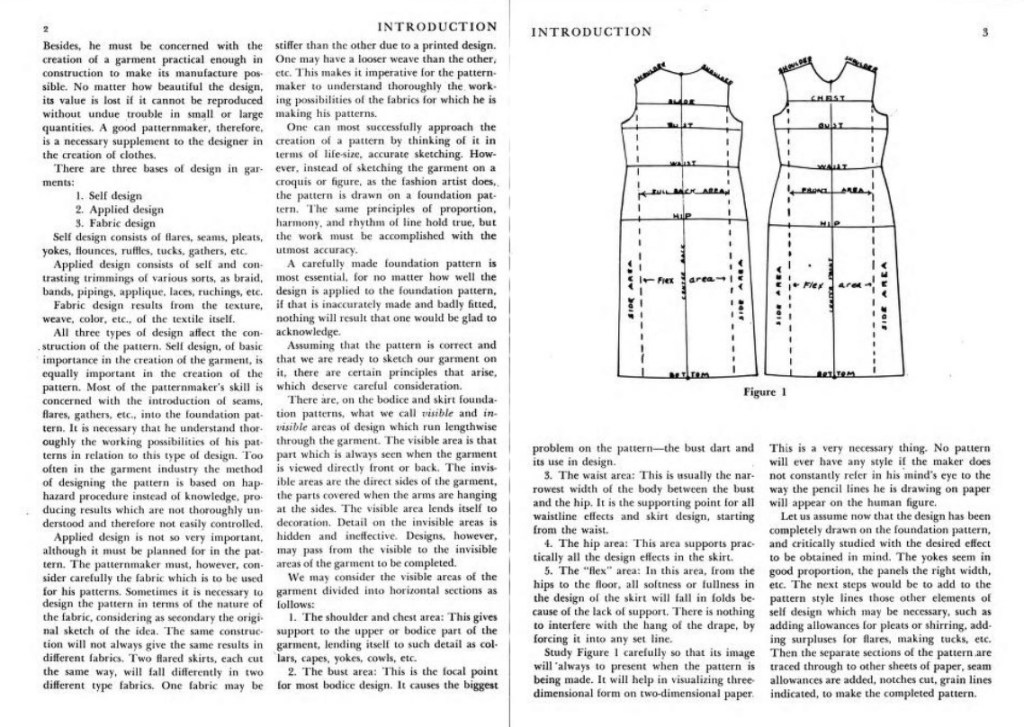
Here are screen shots from the book. I was surprised to see that the skirt is similar to the result I obtained when using the Precision Draping technique from the 1947 book by Nellie Weymouth Link. There is a slight flare to the skirt. It is not the straight, tubular shape of the 1950s basic skirt.
Here are screen shots from How to design beautiful clothes which show the resulting basic front and back bodices; back and front skirt patterns; and a diagram showing the measurements needed.
Close-up of the vintage pattern drafting instructions circa 1960s.
On 6th January 2022, I posted screen shots of an original 1960s pattern drafting instruction sheet. Since the original is faded, I typed up the instructions along with my comments. The instructions are the simplest flat pattern drafting instructions I’ve used so far. In this posting I evaluation the half-toile created using the measurements for a Misses Size 4. Please click this link for the pattern drafting instructions
Evaluating the Results
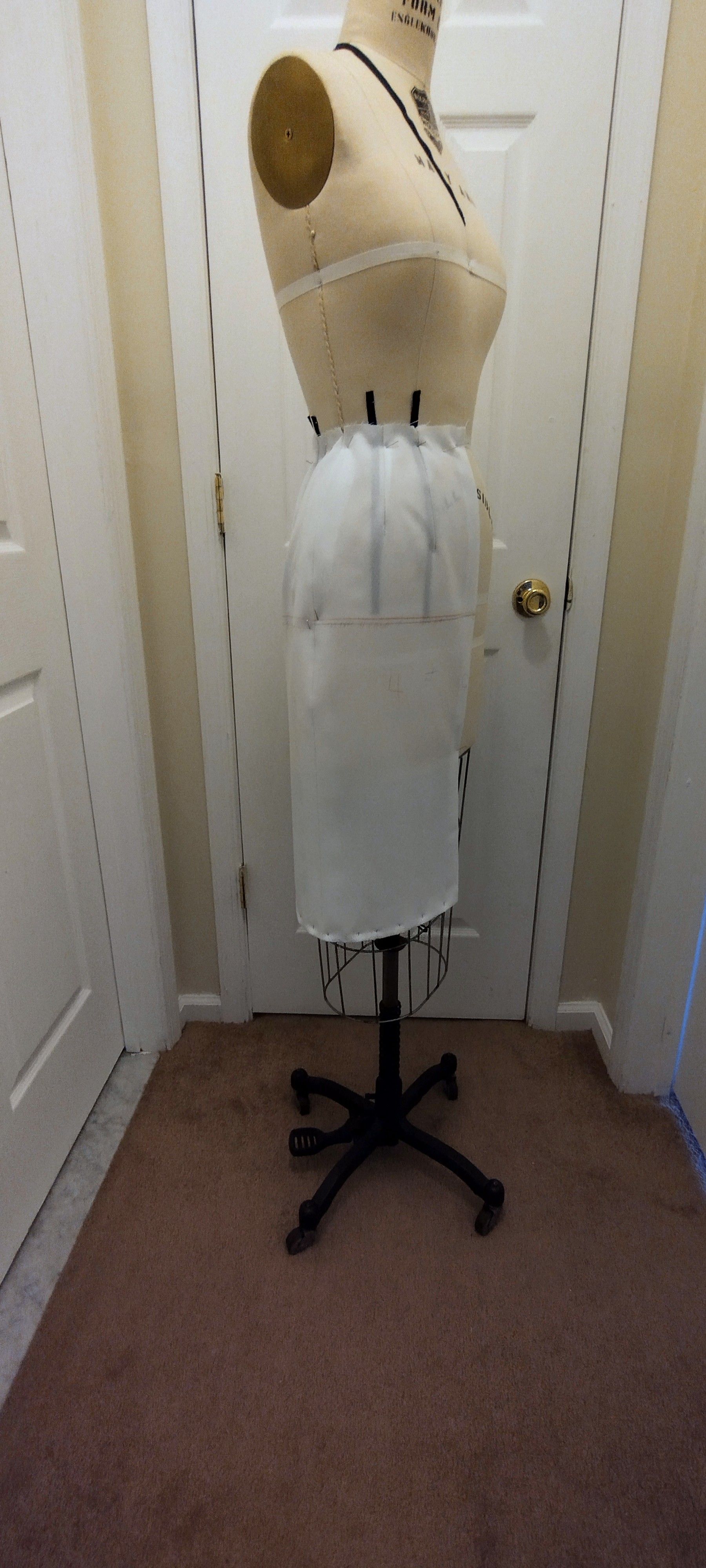
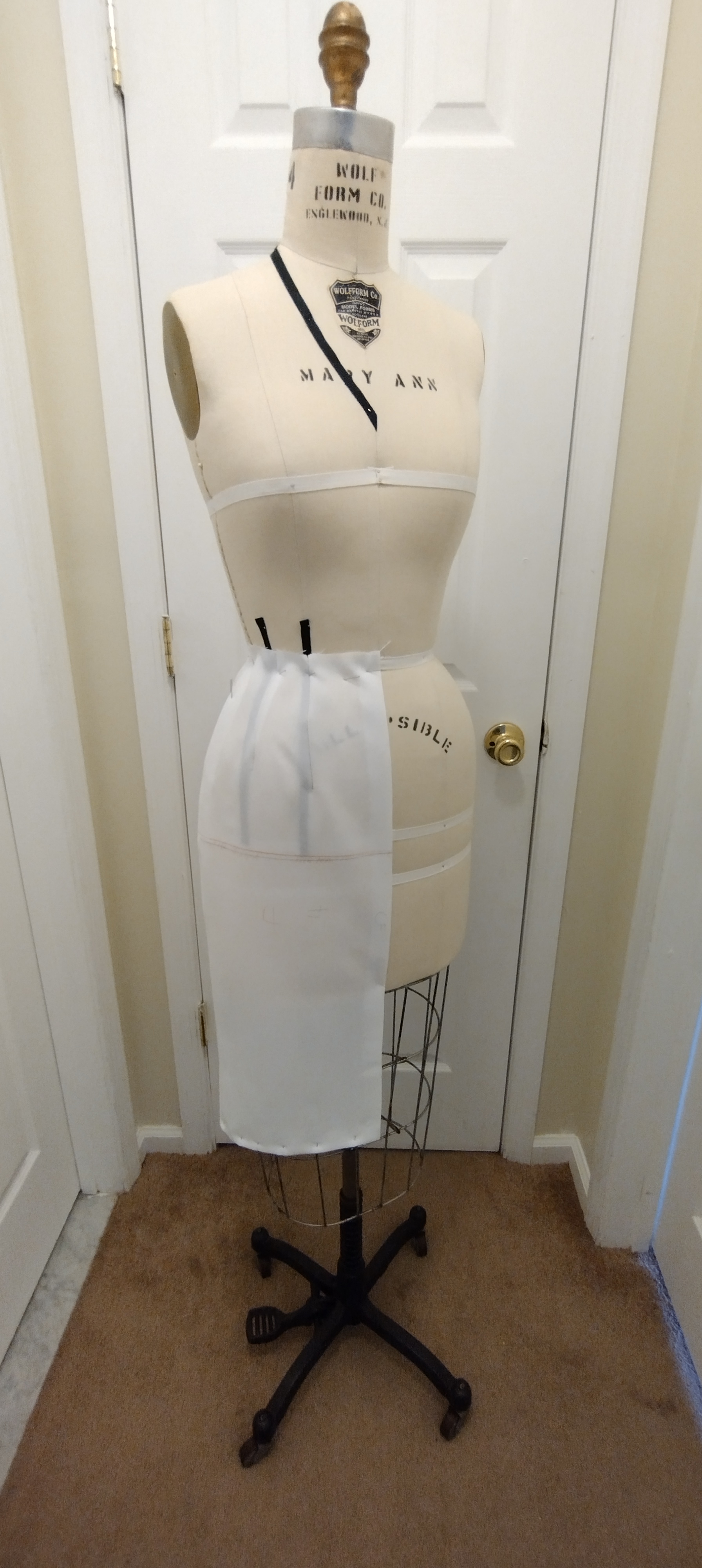
Front (l) and back (r) views of the sheath skirt half-toile.
The instructions about dart placement referred to a basic bodice with a vertical dart under the bust. The position of the first dart for skirt front and back had to align with that dart on the bodice. I used the measurement from Center Front to Princess Line and the waist. For the back skirt I measured from Center Back to the Princess Line at the back waist. The second dart was located in the center between the princess line and side seam .
I am very pleased with the fit of the skirt. The drafting instructions state that 2 inches is added to the hip measurement for ease. However, no ease is factored in for the waistline. Considering that I will use a waistband and perhaps a lining I knew ease at the waist was essential. I also know the blouse I envision for the outfit will be tucked in. I added 1″ to the waistline and then drafted the skirt.
Views of the half-toile to show how hip curve looks.
The only correction I have to make is mid-way along the hip curve. Once the curve has a more even line the pattern will be ready for cutting the fashion fabric.
Size Misses 4 measurements are used as an example.
Waist=23″
Front Skirt Length=24″ (40″-16″=24″)
Calculate One Fourth of the Waist Measurement: 1/4 of 23″=5 3/4″
Add to the measurement obtained:
1 3/4″ in case of waist measurement from 22 to 26″
2: in the case of waist measurement from 26 to 30″
2 1/4″ in the case of waist measurement from 30 to 34″
2 1/2″ in the case of waist measurement from 34 to 38″
For Misses Size 4 the waist measurement to use is 5 3/4″ + 1 3/4″=7 1/2″
Drafting the Half Circle Skirt Pattern
Make a Right Angle and apply on both sides the result obtained from adding the ease to one fourth of the waist measurement. For Misses size 4 that is 7 1/2″. Refer to pattern illustration. The 7 1/2″ down from the corner are points A-B and A-C.
From B following the A-B line, apply the measurement of the Front Skirt Length. (example, Misses Size 4=24″). Mark the Skirt Length as Point D. Points B-D become Center Front and Center Back of Skirt.
From C following the A-C line, apply in the same manner the measurement of the Front Skirt Length Mark the Skirt Length as Point E. Points C-E are Side Seams of Skirt.
Fold the skirt pattern in half by bring A-B-D over to A-C-E. Crease.
Fold the skirt pattern in another half. Crease.
Open the pattern. The three fold lines represent the rays of the pattern.
From A measure down the A-B distance along the other creases. Mark with a dot. See pattern illustration. Mark each dot F, G, H.
Join points B-F-G-H-C by means of a curve to get the curve of the waistline.
From Points F, G, and H measure down the skirt length along each crease. Mark with a dot. You will mark them I, J, K. Refer to pattern illustration.
Connect D-I-J-K-E for hemline curve.
Cut out the pattern. The grainline can be along B-D when placed on the fold for Center Front and Center Back.
Notes
I advise creating a fitting toile since you may need to adjust the waist at the side seams. Half Circle and Full Circle Skirts cut into the bias. The waistline may stretch a little.
To stabilize the waistline, stay stitch after cutting. Do not hang the skirt up until the waistline is finished with a facing or waistband. Then hang the skirt for 2 days or more so that the drape sets in.
A lapped side zipper is one of my favorite closures. It does not interfere with the drape and the flares.
The measurements used in this pattern are for a Misses Size 4. They are used to provide an example. You will substitute your own measurements to draft your custom pattern.
The Flattering Qualities of a Gored Skirt
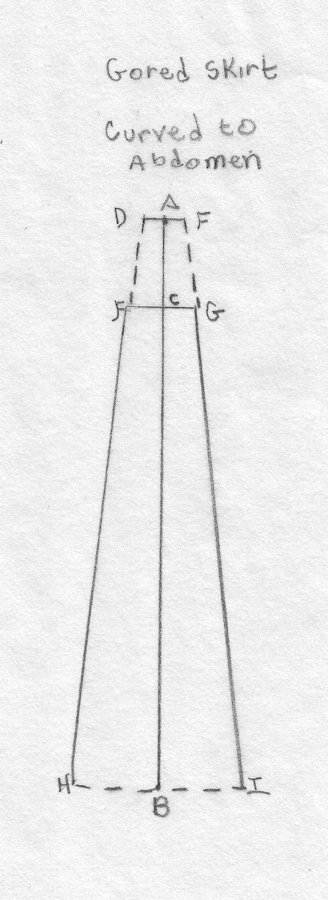
Gored skirts are flattering to all figure types, especially when the pattern is drafted to your own measurements. This is because the pattern is drafted with a slight curve from waist to abdomen or waist to hipline. After the slight curve, the line becomes straight and ends however many inches from the center of the skirt that you want. The greater the width of the hemline the more flare and movement the gores will have.
The point at which the curve stops is best determined by your own hip and abdomen measurements. In general these are the guidelines:
If your hips are larger than your abdomen let the flare start at the hipline. If this is your body type, then you will use the measurement Waist to Hip line for points A-C.
If your abdomen is larger than your hip let the flare start at the abdomen. In this case you will use the measurement Waist to Abdomen for Point A-C.
The Front Skirt Length used is completely up to you. A length of 27-30” will give you a retro looking skirt reminiscent of the 1930s. To achieve such an effect use the diagram for creating a Trumpet Skirt with flare starting at the hip line.
Style Ease to add to measurements
For a gored skirt add 1-2” of ease for the abdomen or hipline. To the waist add about 1/2″ of ease.
Measurements (used for an example) for a Gored Skirt Pattern
The measurements used here are for a Standard Size Misses 4. They are used as an example. Substitute another Standard Size or your personal measurements.
Waist 24”+ 1/2″ ease=24 ½”
Abdomen Circumference 35”+1” ease=36” OR
Hip Circumference 36”+ 1” ease=37”
Waist to Abdomen 4” OR
Waist to Hip 8”
Front Skirt Length 28”
Drafting Instructions for a six gore skirt
You will be dividing the waist, abodomen or hip measurement by six. If you want to create an 8 gore skirt you will then divide by 8. If you’re up to it you can also create 10 or 12 gore skirts. The number of gores you want will determine the number by which the waist and hip or abdomen are divided.
The diagrams show the completed skirt pattern when the pattern is cut and opened. To draft we will need to draw only half the pattern.
Cut a sheet of pattern paper the front length of the skirt plus 5-6”. The width should be about 20 inches.
6 gored skirt pattern
1. Draw a vertical line equal to the Front Skirt Length. Label A at the top and B at the bottom.
2. Fold the paper along the A-B line. You will draft with the pattern paper fold on your right hand side and the paper towards your left hand side.
3. From A mark down the length of Waist to Abdomen or the Waist to Hipline Measurement. Dot this and mark as point C.
For a Misses Size 4 skirt with flare from Abdomen Point C is 4” down from A.
For a Messes Size 4 skirt with flare from Hipline Point C is 8” down from A.
4. Take the Waist plus ease measurement and divide by the number of gores wanted. In this sample pattern the Size 4 waist plus ease measurement is 24 1/2″. So the calculation for a 6 gore skirt is 24 1/2″ divided by 6 equals 4.08”. Round off to 4”.
5. Apply half of the amount derived from the calculation performed in Step 4 and measure out from Point A. Label Point D.
6. Take the Abdomen plus ease or Hipline plus ease measurement and divide by the number of gores. For a trumpet skirt in Misses Size 4 the Hipline measurement will be used. So the calculation is:
Hipline plus ease is 37 divided by 6 equals 6.16. Round off to 6”.
7. Apply half of the measurement obtained in Step 6 and draw a straight line from Point C. Label Point F.
8. Using the hip curve position the part with the slightest curve against points A and F. Draw a very slight curve. It should not be too pronounced of a curve but not a straight line either.
9. Taking a tape measure, place the start of the tape measure at Point D, continue past Point F and from Point F straight down until the Front Skirt Measurement is reached. Dot this as point H.
10. Connect Point B to H with a slight curve.
Trumpte skirt pattern.
12. If you want a dramatic flare or are drafting the Trumpet Skirt pattern, measure out from Point H 1” or more. The greater the amount you measure out the greater the flare will be at the hemline. I find 1 to 1 1/2″ good enough. Mark the new Point H and redraw the line from F to the new point H.
Connect Point B with the new Point H by a slight curve.
13. Cut out the pattern and open it up. The gored piece is now completed. This represents one gore of the six gore skirt. You will have to cut 6 pieces. To make it simpler, fold the pattern piece again and cut two more pattern pieces if you like.
14. 1/2” seam allowances are added when the fabric is cut.
IMPORTANT: I strongly advise making a muslin to test the fit and amount of ease. This will save you so much effort once the fashion fabric is cut.
Grainline for this pattern
The vertical A-B line can be used as the lengthwise grain line.





 Pour Moi
You must be logged in to post a comment.