1930s Skirt and Blouse: Finding the Focal Point

Introduction

This week I reviewed the first sketch made for my next project, a 1930s inspired skirt and blouse. I do not have much experience working with styles of this decade, so it is a big challenge for me. I have only made one dress using design elements from a 1930s book, Paris Frocks at Home. That dress was designed as what I envisioned a woman would have as a special occasion dress during the Great Depression. It was pretty enough for a semi-formal occasion and yet could be worn for more everyday events such as a Sunday visit.

With my new project I am envisioning how a woman would dress for work during the 1930s. I want the skirt and blouse to be pretty and attractive enough to be wearable for today. For this reason I am taking only certain elements from the 1930s, not all of them.

I re-thought the first sketch and was not satisfied with it. I will detail the reasons here while sharing the importance of maintaining a clear focal point for any design.

What is a focal point?

A focal point is that part of the outfit where you want to:

–direct the gaze of the viewer
–emphasize a feature and make it attractive
–express an idea about the outfit, i.e. what is the message

Importance of integrating a focal point into the flow of the design

A focal point must be in harmony with the overall appearance and purpose of the outfit. It has to have pleasing proportions and add to the wearers attractiveness. Learning how to balance focal points takes experience. You want at least one, perhaps two. But never so many that the eye does not rest on any particular area and then move to what feature you are emphasizing. For example, in Version 1 of the 1930s outfit there are, I think, conflicting focal points. The scalloped yoke of the skirt competes with the bow of the blouse.

Version no. 2 of the skirt and blouse appears more calm and pleasing to the eye. The flounce at the bottom of the skirt emphasizes the movement when the wearer walks. A second focal point is the v-neckline of the Peter Pan flat collar. A small, marcasite Art Deco broach can be pinned at the neckline to create a second focal point. Or, very pretty but small buttons may be used to create the second focal point. Here there is a more sublte play between the focal points that Version no. 1 lacks.

How to compare focal points and choose the right combinations

One way to choose the right combination of focal points, or choose to have just one focal point, is to make separate sketches of the parts of the outfit. Then make a complete sketch of the outfit put together.

1930s skirt and blouse sketches and notes, Version no. 1
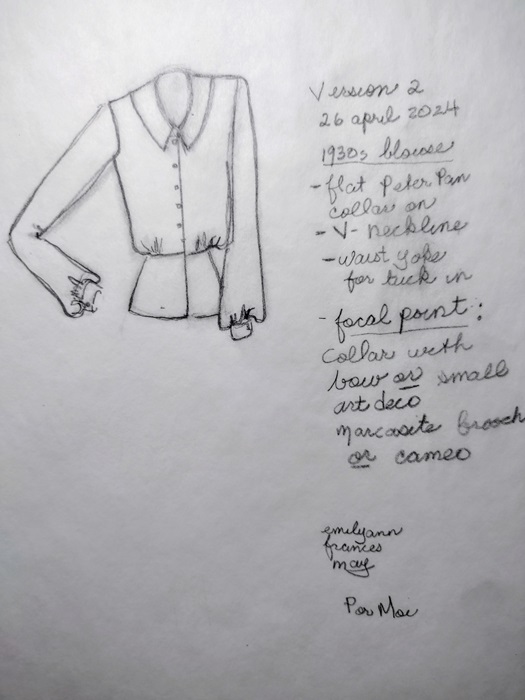
1930s skirt and blouse sketches and notes, Version no. 2.

If doubts remain about the current pairing of separate parts of the outfit, the sketches of the garment pieces can be mixed and matched. This gives some idea on how the elements might or might not work together in a different combination.

Blouse Ver. no. 2 is paired with Skirt Ver. no. 1 on the left. On the right Blouse Ver. no 1 is paired with Skirt Ver. no. 2.

It helps if the sketches are put aside for a day or two. Then they can be reviewed again with a fresh point of view. When performing this review, be aware of what first captures your attention. Then consider how that first focal point works with other elements in the design.

Through this process of sketching, considering, studying and planning you will come up with an important and clear definition of how to proceed in the next steps of your design plans.

My final choice: Version no. 2

Additional Resources

To learn more about focal points in fashion please visit:

UEN Utah Education Network
Emphasis_the_Focal_Point_of_Fashion_1_.pdf
Scroll down and on the right side of the screen are free course materials you can download that will help you understand what the focal point is about.

Purfe: Fashion, design and perfect fit
“Basic Principles of an Outfit Layout: Focal Point”
October 14, 2012
by Olga

New project: 1930s Inspired Skirt and Blouse

Introduction

Here are some ideas for my next patternmaking and sewing project. I will use the 1930s inspired sloper I just finished.

Complete outfit

Blouse made with white crepe or dull, silky fabric in white.

Bias cut bow in pale pink.

Skirt in mid-weight fabric like gabardine or linen-like wrinkle free fabric.

Accessories: The bow and pearl earrings.

The Blouse

Blouse has waistline yoke. This is not a peplum. It is a feature that was common in blouses of the 1930s through 1940s. The lower portion is tucked into the blouse. The yoke creates a smooth look under the skirt.

All dart intake and style ease will be gathered into the waist of the yoke.

Flat Peter Pan Collar of Peter Pan Collar with a slight stand.

Bow is bias cut and goes under the collar. Tied into a bow at center front.

1/2″ buttons. Maybe mother of pearl. Depends on the fabric.

Slightly puffed Bishops Sleeves at cuff. 1″ cuffs. Use the fitted sleeve with vertical dart as the basis.

Yoke length from waist to a point between abdomen and hip.

The Skirt

Skirt length: 28-30″ from waist

Hem to be finished with 2″ wide hem lace.

8″ zipper at center back.

Underline yoke of skirt so that a hidden zipper can be sewn by hand at center back.

Flounce is cut in the bias at center front and back.

Skirt yoke is placed on top of flounce and top stitched into place.

What are style lines?

Introduction

The basic pattern, a/k/a sloper, is the blueprint of a person’s body. It is a one dimensional representation of the measurements of the body used within a pattern drafting system. Or, the dress form itself is the basic pattern in three dimensional form. It represents the standard size or the size of the person for whom it was custom made.

The process of working the basic pattern into an individual style is called pattern transformation. Style lines are used to map out how the emerging style will look. They are drawn onto the basic pattern. Alternately, style tape is pinned to the dress form to show how the garment pieces will look. This helps the draper know where to mold the fabric and how the garment piece should look.

Analyzing an outfit and seeing the style lines

A knowledge of the different forms sleeves, bodices, skirts, collars, pants and dresses can take helps in analyzing an existing style. Rough sketches help clarify if one is seeing the style lines correctly or misinterpreting a photograph or sketch someone else has made. Of course the best way to analyze a garment is to see it in real time. That is not always, possible, though. When one is inspired by a vintage style sketching and studying photos is one way to help in the recreation or updated expression of that style.

An economical way to practice visualizing and understanding stylelines is to have a library of basic bodices, sleeves, skirts and slacks printed on 8 1/2 x 11 paper. With colored pencil or pen these copies can have style lines drawn over them. Immediately you can see the blueprint for the pattern transformation. Which darts and seams the style lines intersect with also comes to the fore. It is possible to get a better idea what needs to be done for the actual transformation.

Example of a style analysis and practice transformation

This photo comes from a 1964 edition of the Saturday Evening Post. Fashions from Hong Kong were featured. This cocktail outfit consists of a silk sheath shirt and unfitted, sleeveless blouse.

On copies of a basic bodice and basic skirt, fronts and backs, style lines are sketched and notes added to better understand one possible way to recreate, or at least interpret, the original 1964 fashion.

I hope these suggestions help you in your next vintage inspired style recreation or adaptation.

Dressmaker’s Library:  Drawing the Fashion Figure for Body Positivity

Introduction

The standard croquis favored in fashion illustration is an elongated, slender figure that can be 8, 10 or 12 heads high.  However, this style of croquis is not a modern model of beauty.  It has come and gone with variations throughout the 20th century and into the current time.

Fashion designer Erte favored an elongated figure upon which to draw his extravagant designs worn by high society women and actresses on stage during the late 1910s.  The boyish, angular fashion figure of the 1920s gave way to the willowy, softly curving fashion croquis of the 1930s.  Come the 1940s and 1950s the feminine form filled out and there were some artists writing and illustrating their own books showing students, aspiring illustrators and hobbyists how to draw male and female figures more reflective of the everyday body shapes .

In this posting I share screen shots of three fashion illustration books that I hope put the subject of body positivity and fashion illustration into a historical perspective.

My purpose is to set forth a balanced perspective not only in books that provide croquis to trace over.  I also want to make more widely known books that show you how to draw a body positive croquis in a step-by-step approach.  All croquis are based upon preliminary drawings consisting of ovals, rectangles, cylinders, circles and wedge shapes.  With practice you can gain even a rudimentary ability and in time you will be able to do quick sketches.  The key is to practice and let your hand movements flow without fear or worry. Enjoy the process and discover what is waiting to be expressed.

It is good to know how to draw croquis of different sizes and styles.  This diversifies your skillset and helps connect you as a dressmaker to a broader sense of proportion based on different sizes.

The style of croquis you use should be the one that pleases you and best expresses the idea you are working on.

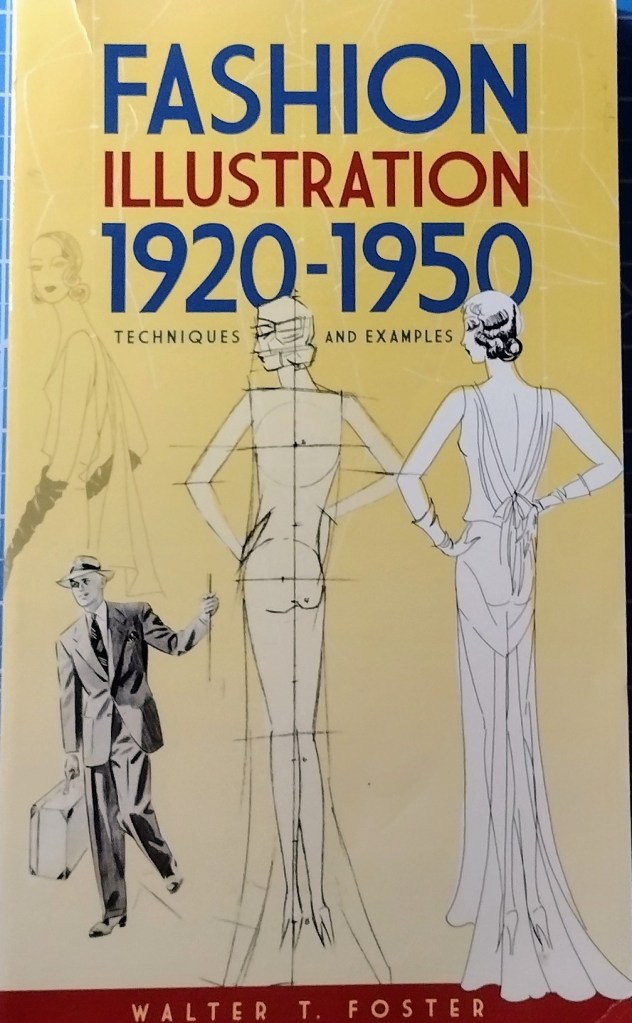
Fashion Illustration 1920-1950
Techniques and Examples
by Walter T. Foster

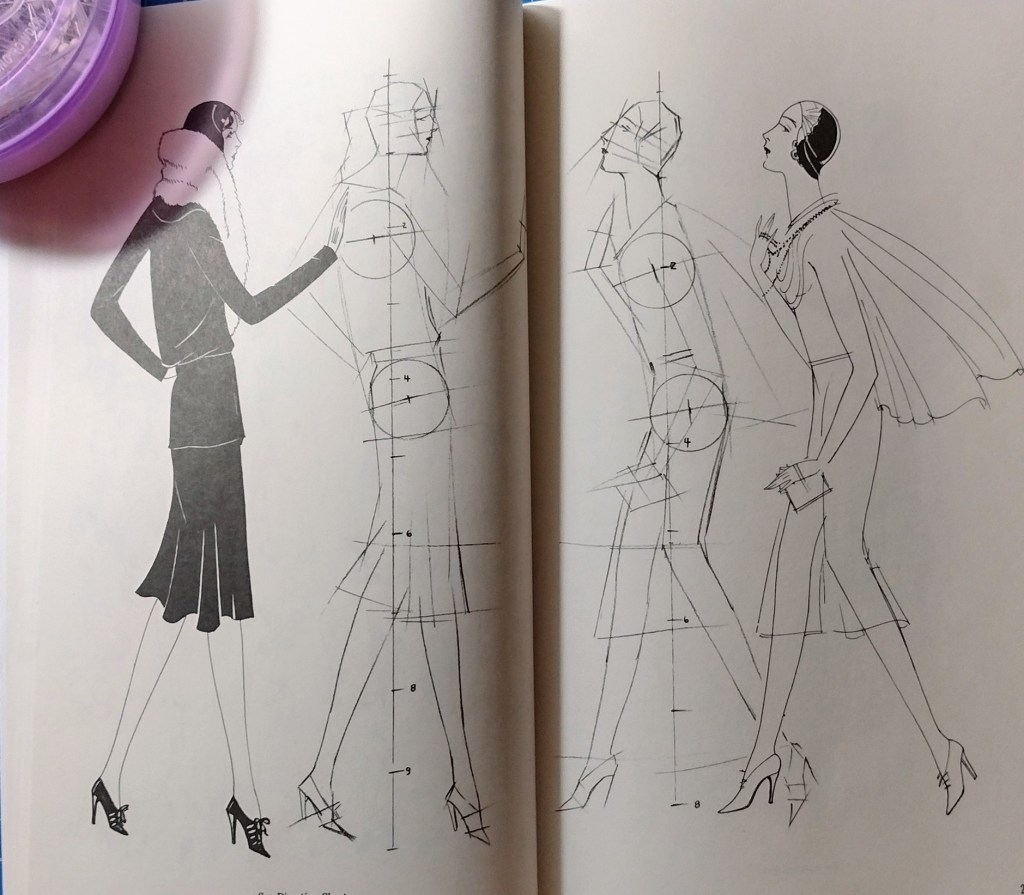
Foster’s book offers detailed diagrams for figures and clothing of the period from 1920s to 1950s.  This is one of my favorite books for fashion illustration because the figure changes with each decade.  Male and female figures are given and detailed.

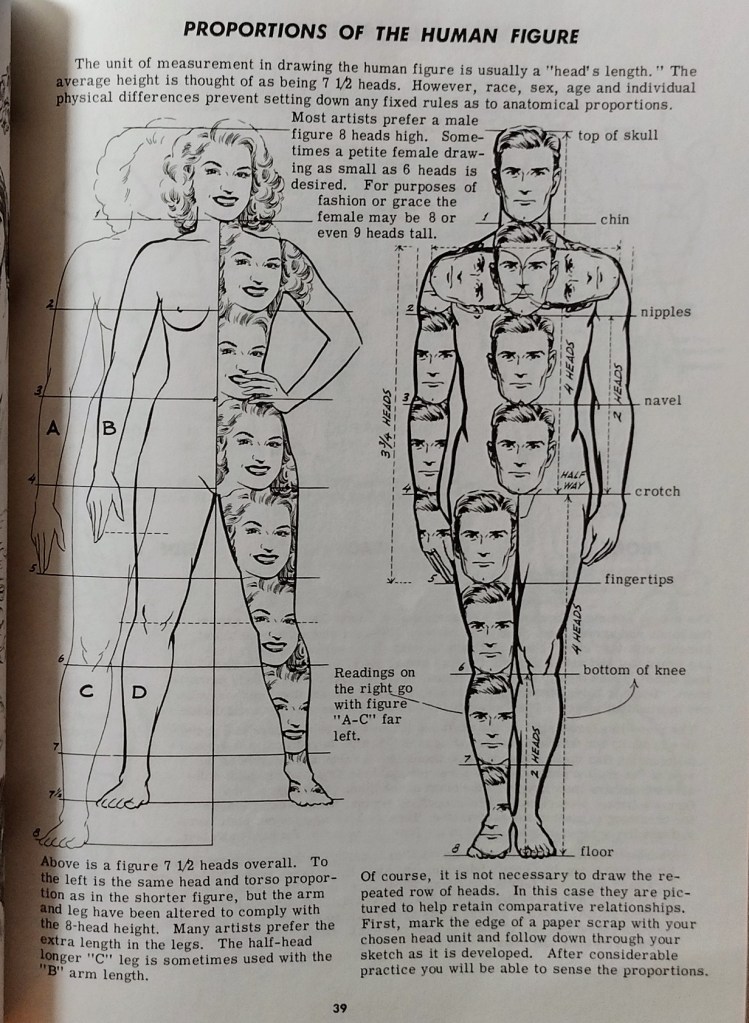
Drawing the Head and Figure
by Jack Hamm

This book was published in 1963.  The croquis and technique used will help you draw figures in tune with the current call to create more realistic renderings of female body shapes.  The technique used in the book will provide looks that work well with retro styles of the 1940s and 1950s.  Examples are also give for drawing the male figure.

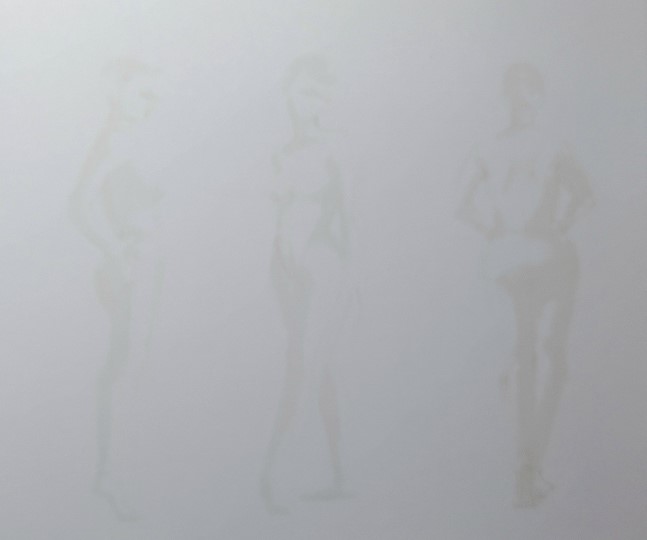
Gertie’s New Fashion Sketchbook
by Gretchen Hirsch

The premise of Gertie’s book is a good one.  Gertie’s body positive croquis are intended to represent the a more realistic body upon which clothes can be sketched. The croquis are smaller than most standard sized croquis.  The upper and lower torsos are each two heads high with the length of each head being about 3/8 to 1/2 inch high. Each page has two to three croquis in different poses (front, back and side views).

The drawback is how faint the croquis are on each page. This is not a book of figures to trace over. Rather these are figures to draw on.  Each page is perforated and meant to be torn out and drawn over.  Because the figures are so very lightly printed I’d recommend using the pages over a light box.  Otherwise a very bright desk lamp is needed to ensure you draw the lines as best as possible.

Gertie’s croquis remind me of the ones Jack Hamm drew, only his are bolder and easier to render if photocopies are made and then traced over.

The Fashion Croquis: Preliminary Sketches of Ensembles

Introduction

The full figure does not always have to be drawn in and developed. When you need to focus on the ensemble itself, you can sketch just the outfit and accessories using the croquis under a sheet of tracing paper.

Developing the sense of proportion and harmonizing accessories

When you are exploring proportions, acceossories and the total look of an ensemble the full figure can be omitted from the sketch. Sometimes the only detail I add is a hairstyle.  This initial sketch helps finalize the personality of an ensemble.  From there a second sketch can be made, this time drawing in the figure and expression on the face.  Remember, the croquis is a muse and flight of fancy.  You are free to depict both as your imagination concieves of them.

The Fashion Croquis: Muse and Model, source of inspiration!

Introduction

The fashion croquis is meant to represent a stylized version of the dressmaker’s or designer’s muse. The form does not have to be realistic. The purpose is to use a representation that enables the imagination to become inspired. The croquis is a means upon which to bring an idea to life in it’s very first stages.

Sources of Inspiration

The appearance given to the croquis is meant to be dramatic. It should tell the story of the creator’s vision and the aesthetic upon which the designs are based. In the initial stages proportions, colors and poses can all be exaggerated. The key word is inspiration.

Realism of the figure and the proportions of the garment details are worked out later, once the draping or patternmaking begins.

My personal choice is the 10 or 12 heads croquis that represents a tall, willowy and slender woman. My inspiration is rooted in the artwork of Erte. As well, I take inspiration from the illustrations in the stylebooks of Marfy Studio. My reasons for choosing this style of croquis is that I find great enjoyment in the sketching as well as the sources from which I derive that inspiration.

IMy sketches always have a cartoon-like quality to them. Again, it is to give the finished sketch a sense of light-heartedness. When it comes to sketching a design it is up to the individual to choose the kind of croquis they use. Nobody can dictate which one is right or wrong. Go with what best expresses your creative vision and move forward from there.

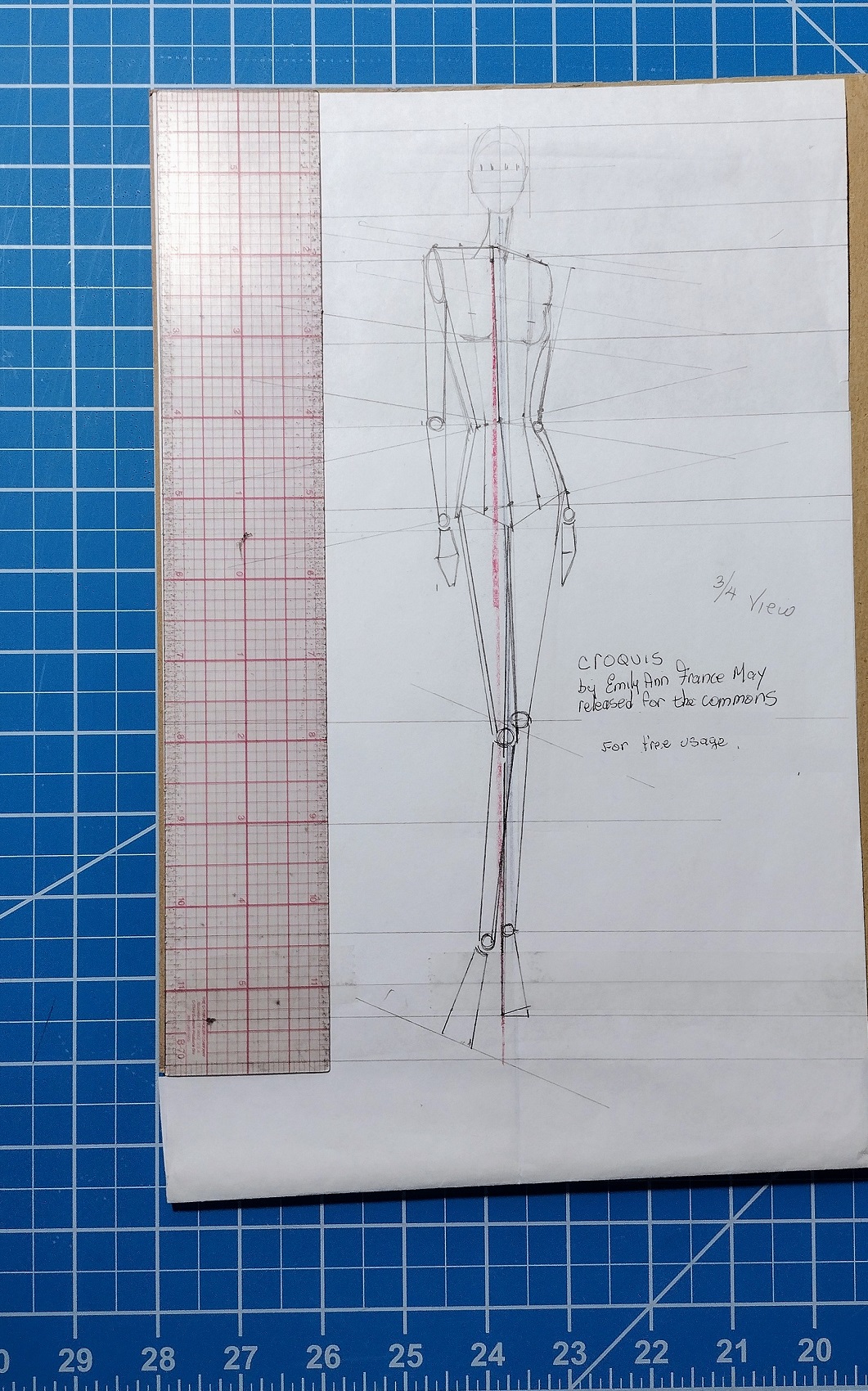
My 3/4 Croquis which you may copy, distribute and use

My sketches using the 3/4 croquis

The above sketch was made using the 3/4 10-heads croquis. Notice how it is filled out. The croquis because it represents the bone structure of the figure will always be slimmer than the final sketch. I like my sketches to look old, as if they came from a vintage sketch book, comic book or series of drafts from long ago. To get that look I use colored pencils and color from the wrong side of the sketch. I also use crayon on the wrong side and then smudge with a Q-tip.

Preliminary Sketch for New Project-Chambray Shirtwaist Dress

Introduction

I always start a project with a sketch. It acts as a roadmap. Once a fitting toile is made, the style may take on further changes. It depends on the resulting drape and other details I may want to add. Right now, I am considering this shirtwaist dress with additional details. The most practical are pockets set into the side seam. A shirtwaist dress is a working garment so I see the pockets as important. They can hold my keys, some money or receipts when I have to go to the lobby for a delivery or am at the laundry. Yet I want this dress to have a feminine look. I might also go to meet a friend or pay a visit while out. In this case I think a bracelet and small earrings are good. Pretty buttons also add a feminine touch.

A fashion sketch starts with a croquis. Here is how I make one and the reasons why a croquis is important.

The process of creating a preliminary sketch

10 1/2 heads tall croquis.

The function of the croquis is to provide a foundation upon which to project one’s vision of the style. It helps create an awareness of the body contours under the garment. Croquis can be shaped as you please. I use the 10 1/2 heads size because I like working with the elongated silhouette. I have a preference for the early 20th century artist Erte and take some inspiration from his work. You can also have croquis more life-like as to size and proportion. It is a kind of interaction between a person and their vision that will determine the kind of croquis to use.

To save money for fabric and notions I use simple supplies available at the 99 cent stores or Dollar General. Number 2 pencils, white tissue paper used for gifts, tracing paper, erasers, coloring pencils, and white copy paper. The croquis is drawn on white copy paper.

First sketch. Tissue paper over croquis. Shoulder pads added.

For the first layer, I use white tissue paper. This saves the tracing paper for the final sketch. Here I have drawn in a shoulder pad. Since I have slightly sloping shoulders I plan to make custom sized shoulder pads as a corrective which ensures a better fit. The pads will be no more than 1/8″ high. Having the shoulder pads drawn in results in the next sketch better reflecting how the shoulderline, collar and sleeve will look.

First sketch on 2nd layer of tissue paper.

Another layer of tissue paper is placed on top. The garment details are sketched in. I like the look of a paper doll so I use a ruler to draw most seams and lines. The hairstyle, jewelry, accessories and shoes are added in this sketch. Design details like tucks, gathers, and so on are also added.

Completed preliminary sketch.

The tracing paper is placed on top of the previous layer. All the lines, angles and measurements of the sheet underneath are not traced. Only the finished lines and features meant to convey the garment and style sense. I take the tracing paper off and color in on the opposite side using coloring pencils.

Notes about inspirations for notions and other details are penciled in. Swatches of the chambray fabric and underlining cotton are also pinned to the sketch. The chambray is light enough to give a graceful drape to the gored skirt. Since it is slightly transparent, I want an underlining. It will also add just a little extra body to support the in-seam buttonholes and in-seam pockets.

Notions

Once the sketch is completed ideas start to come. I pencil these on the sketch and then search them out. Right now I am thinking that porcelain or clay buttons will go well on this dress. If I go with this choice I’d like the buttons to have a white background and delicate blue designs or a border. Another possibility are vintage glass buttons. So that the buttons remain the key visual element I would make the belt and buckle of the same fabric as the dress. The jewlery can be silver or white.