Born and raised in Dyker Heights when Brooklyn was still a place where middle and working class families lived for generations. Moved to Linden, NJ in 2018 and loving it. Here there is still a sense of dedicated community and a wonderfully diverse population. I enjoy writing my family's history, noir detective movies, fashion design and sewing, and Duolingo.
This posting initiates a series on my adventure into creating a 1930s type sloper in a modern day Misses size 4. I think modern sewistas and patternmakers can get a similar look without the expense of a vintage pattern purchase. Nor will there be the many fitting challenges that come with using a vintage pattern. My goal is to simplify a process of creation, not complicate it or make it overly time consuming. I think if enough research is done, it will be possible to come close to the shapes of a basic sloper for the 1930s.
Draping Technique I will use
I am going to use the 1940s draping system called Precision Draping which was developed by Nellie Weymouth Link. The book has been reprinted and is available at booksellers online new or used. While this is not a 1930s draping technique, it is a vintage one. It is easy to learn and provides a good foundation for exploration into the styles of other decades.
Beginning point
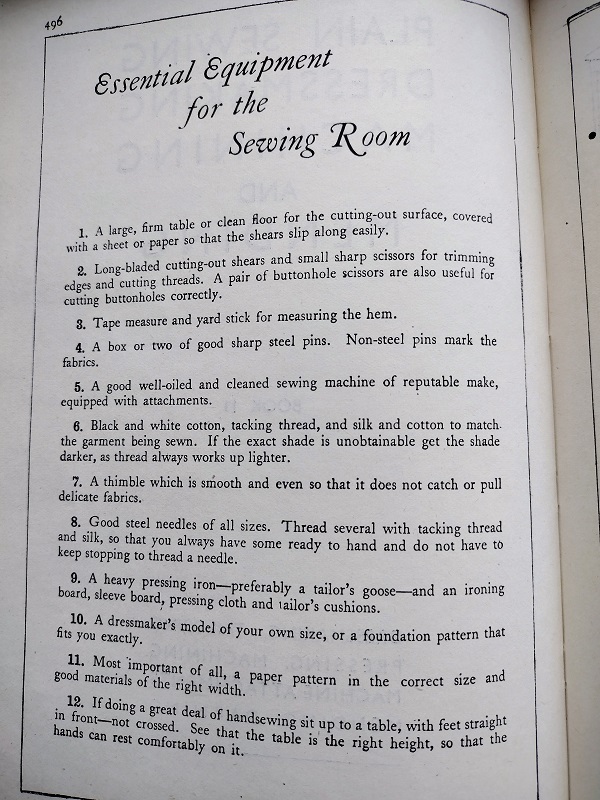
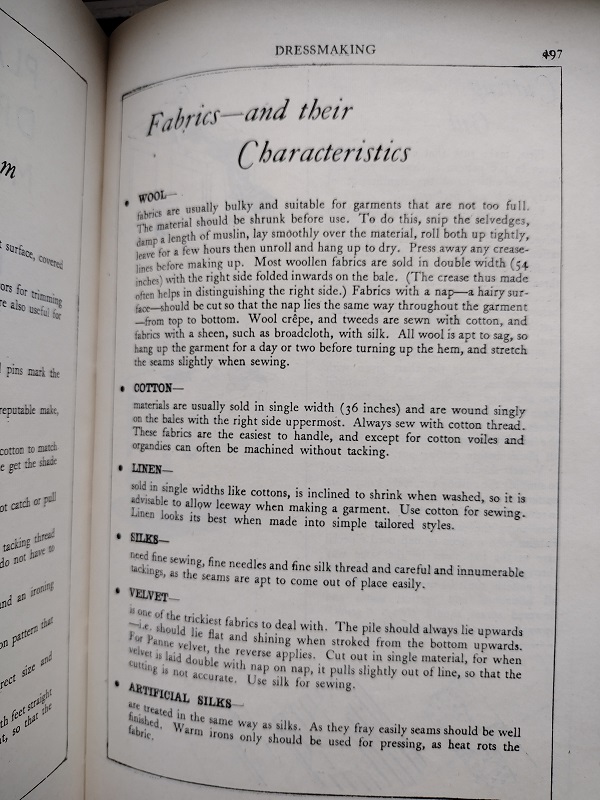
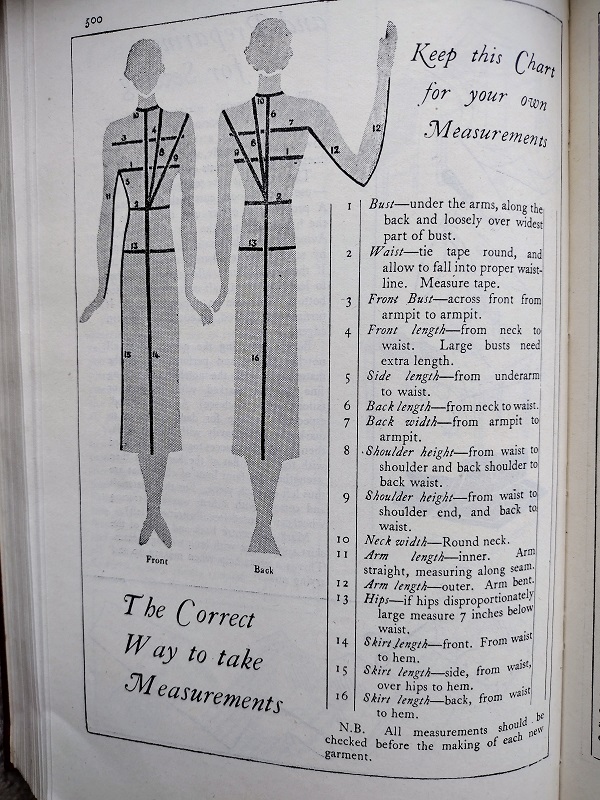
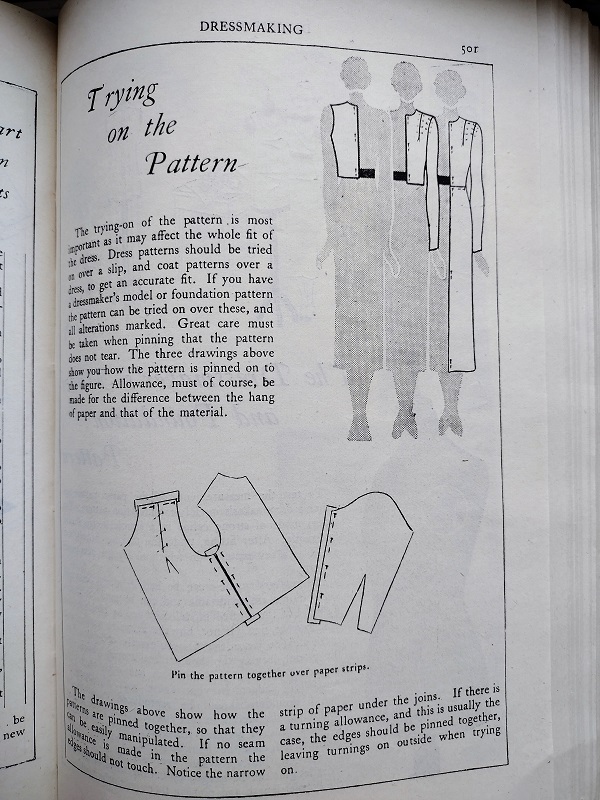
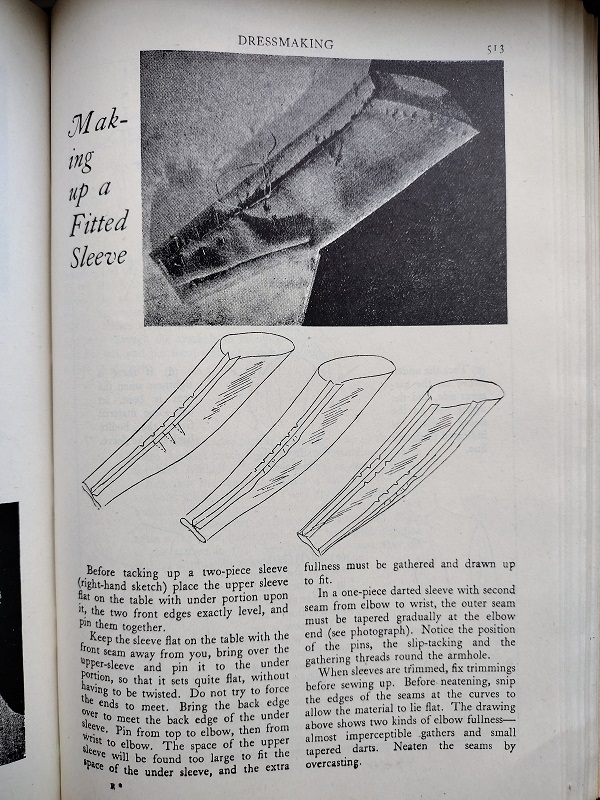
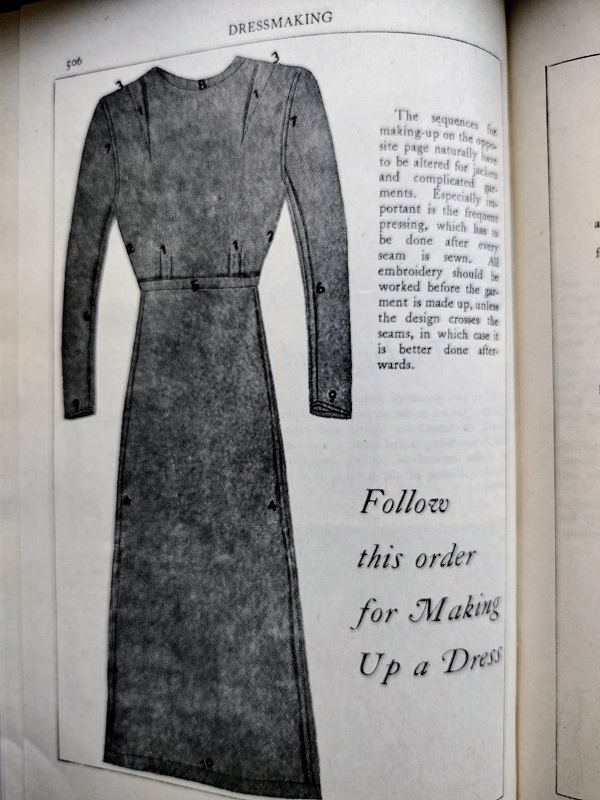
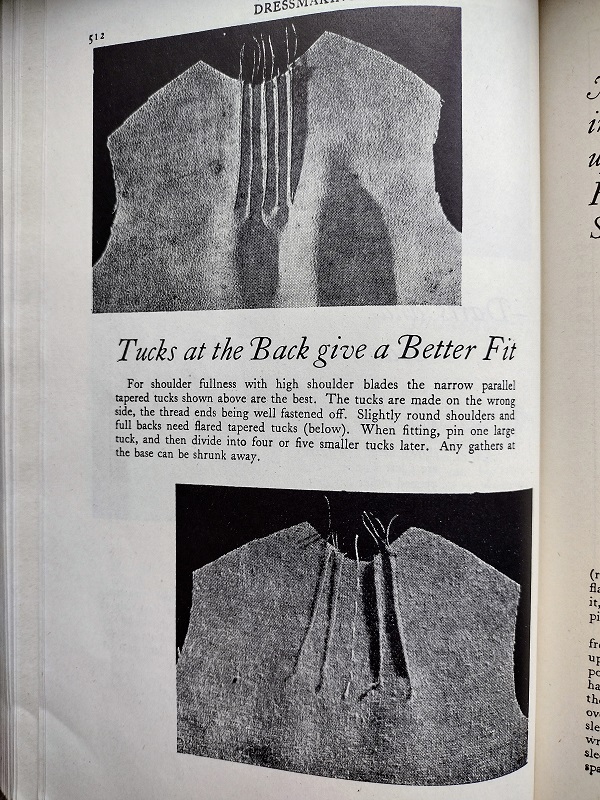
As always, research and reading provide insights and ideas. I begin this journey by making available for you a section of Weldons Encyclopedia of Needlework from my very small collection of vintage sewing books. It was published by The Waverley Book Col, Ltd. of Farringdon Street, London, E.C. 4, but no date of publication exists in the book! I estimate that the edition I have was published in the 1930s. As you can see in the illustrations that follow, the silhouette is close to 1930s fashions with longer hemlines and flowing skirts. The fashion figure is also slender and soft. The boxier fashions with emphasis on the shoulder line of the 1940s is not present in the chapter I post here.
We will continue this exploration into the elements of a 1930 sloper and the key takeaways for creating a sloper that can approximate the look in the next posting. For now I hope you enjoy this look into what a sloper and dress form from the 1930s looked like. What is shown here may or may not be typical but it has elements that appear in another flat pattern drafting system from the 1930s that appear in another book I have and will use in this series.
“The Dressmaker’s Model and Fitting Pattern” from Weldon’s Encyclopedia of Needlework
In my previous posting, “What are style lines?” I explained what style lines are. I showed how a few style lines can be used to transform a basic skirt and bodice into a vintage inspired fashion from a 1964 magazine photograph.
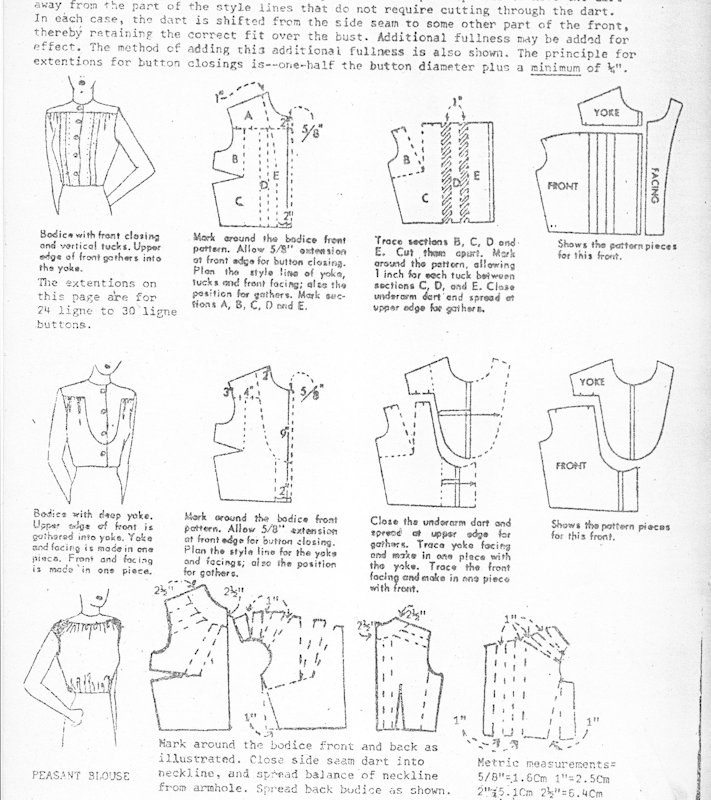
Today, I’m sharing classroom handouts from a vintage patternmaking book. The style lines used are easy to understand and clearly illustrated on the basic bodice. Based on my knowledge of patternmaking it looks like the “slash and spread” method was used. This means, the pattern was created by tracing the basic sloper. The style lines were then drawn. After that, the pattern was slashed and spread when tucks or gathers had to be created. Other patterns were simply cut along the style lines, like the one for the princess line bodice.
I estimate that these pattern transformations are from the 1940s.
The basic pattern, a/k/a sloper, is the blueprint of a person’s body. It is a one dimensional representation of the measurements of the body used within a pattern drafting system. Or, the dress form itself is the basic pattern in three dimensional form. It represents the standard size or the size of the person for whom it was custom made.
The process of working the basic pattern into an individual style is called pattern transformation. Style lines are used to map out how the emerging style will look. They are drawn onto the basic pattern. Alternately, style tape is pinned to the dress form to show how the garment pieces will look. This helps the draper know where to mold the fabric and how the garment piece should look.
Analyzing an outfit and seeing the style lines
A knowledge of the different forms sleeves, bodices, skirts, collars, pants and dresses can take helps in analyzing an existing style. Rough sketches help clarify if one is seeing the style lines correctly or misinterpreting a photograph or sketch someone else has made. Of course the best way to analyze a garment is to see it in real time. That is not always, possible, though. When one is inspired by a vintage style sketching and studying photos is one way to help in the recreation or updated expression of that style.
An economical way to practice visualizing and understanding stylelines is to have a library of basic bodices, sleeves, skirts and slacks printed on 8 1/2 x 11 paper. With colored pencil or pen these copies can have style lines drawn over them. Immediately you can see the blueprint for the pattern transformation. Which darts and seams the style lines intersect with also comes to the fore. It is possible to get a better idea what needs to be done for the actual transformation.
Example of a style analysis and practice transformation
This photo comes from a 1964 edition of the Saturday Evening Post. Fashions from Hong Kong were featured. This cocktail outfit consists of a silk sheath shirt and unfitted, sleeveless blouse.
On copies of a basic bodice and basic skirt, fronts and backs, style lines are sketched and notes added to better understand one possible way to recreate, or at least interpret, the original 1964 fashion.
I hope these suggestions help you in your next vintage inspired style recreation or adaptation.
This project got its start with the pencil skirt pattern. The skirt currently available is slightly flared and more suitable to 1940s styles. For many 1950s styles a slim pencil skirt is needed. So that is what I draped. I then went on to drape a fitted bodice with darts above and below the bust. I also draped a fitted sleeve with elbow dart.
The curve on the pencil skirt breaks at the abdomen instead of the hipline. I want to see if this results in a better fit for the skirt. A fit that is attractive but not too tight. I’m hoping that the skirt will have more comfort and room to move. Not everyone has a smaller abodomen-larger hip measurement. It can also be the other way around! I look forward to seeing if this small difference results in a more flattering fit.
I drape in tissue paper using the Precision Draping technique created by author Nellie Weymouth Link. The tehcnique can be learned through her book of the same name. I will post photos of the progress and look forward to sharing the finished sloper when completed.
Photos of the pattern in progress
Original tissue paper drape is copied again to tissue paper. I call this the second pattern and it will be used to cut a full toile.
Tissue paper drape after marking. Next step is to press the paper. Then trace to a clean sheet of tracing paper.
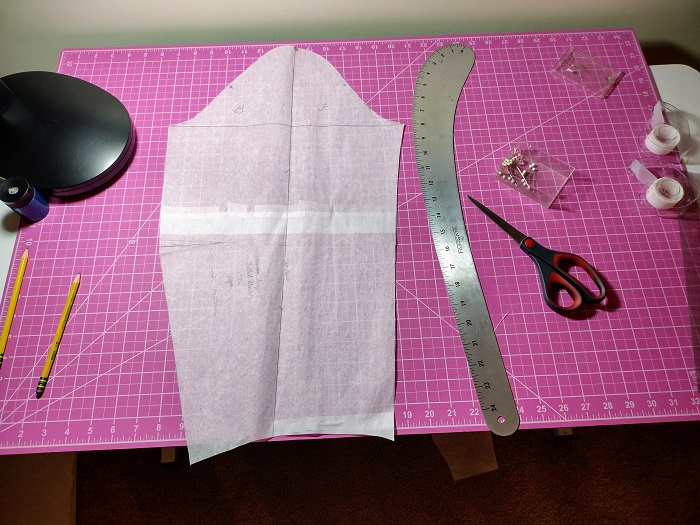
A tracing of the drape was made to clean tracing paper. The fitted sleeve pattern needs a light pressing. Next step: cut the sleeve on fabric and add to the bodice.
This pattern is the result of testing the fit using the second tissue pattern paper. The results were good so the tissue was copied to dotted pattern paper.
Dressmaking Past & Present is a new feature at Pour Moi. Fashion History provides us with inspirations for our personal style. Understanding and learning about techniques used in the past and the present helps us find a variety of methods for possible use in our own projects.
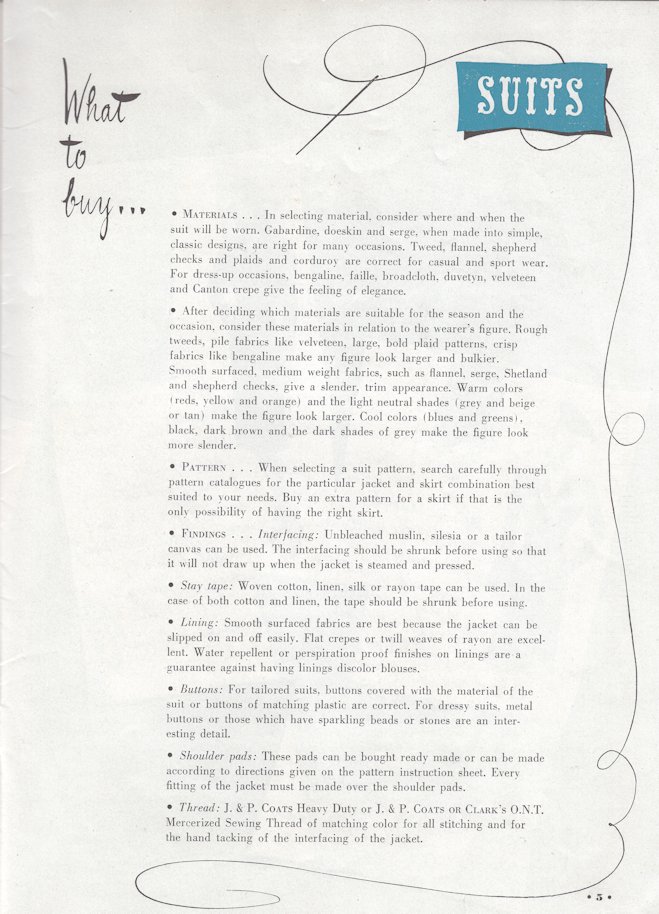
This week, I put up some scans from a small booklet published by Coats & Clark in the 1940s. Dressmaker’s Suits have some tailoring but not to the extent that a fully tailored suit does. Here are some recommendations from the booklet that can help the dressmaker achieve the look in each illustration.
“Tailoring” by Coats & Clark – Tips for sewing a dressmaker’s suit
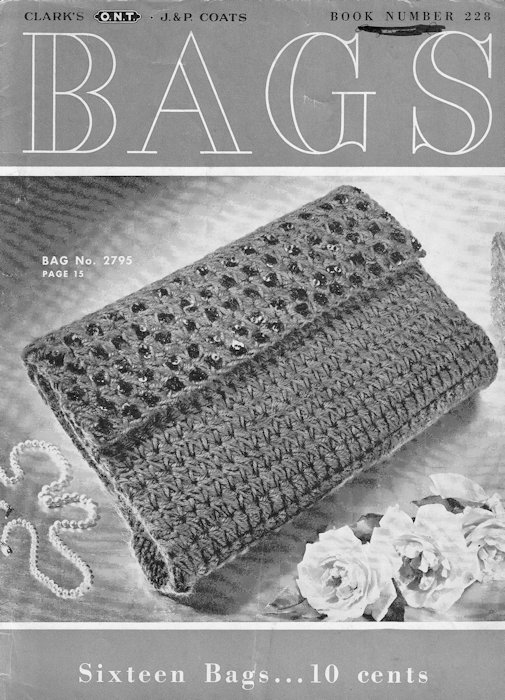
A clutch purse never goes out of style. It can be used for a formal occasion. Or, it can be popped into a larger tote bag when going out for the day and come out later for use. Clutch purses are not meant to hold everything. Just what is needed for an afternoon or evening out: keys, wallet, ID card, compact, comb, lipstick and cellphone are enough.
When I lived in Bay Ridge, a neighbhorhood in Brooklyn, I frequented a craft shop that found a treasure trove of old crochet patterns in the basement of the shop. These pattern booklets were put in a large basket for customers to take . I was very fortunate to find ones that I really liked. Most of the booklets were from the 1970s. I went deeper into the basket and found 3 books. One from the 1960s and two from a period spanning 1940s-1950s.
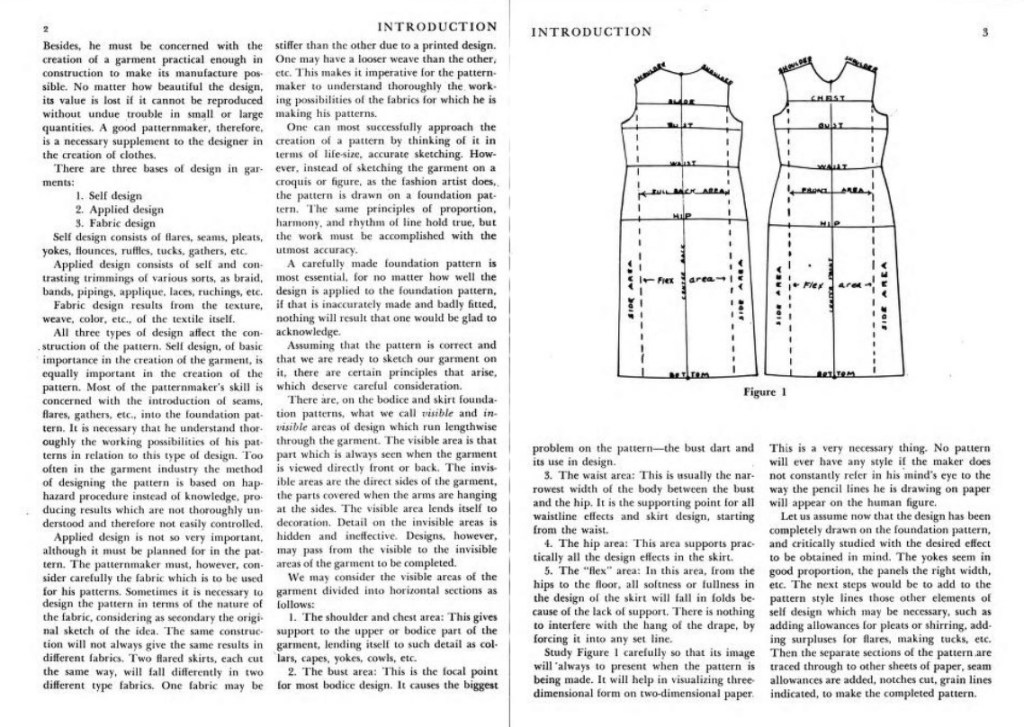
Thanks to the Internet Archive, vintage sewing and fashion enthusiasts can download a PDF version of How to design beautiful clothes, by Esther Pivnick. The book was published in 1949.
The patternmaking system used is the same as what was taught at the Traphagen School of Design in New York City. This book offers a complete guide to taking measurements, creating basic patterns and then transforming them.
Even if you do not use the pattern drafting system, there are details and pattern transformations that can be experimented with using your own sloper. It is well worth it to download a PDF version as the original book sells for over $100 when in good condition.
Here are screen shots from the book. I was surprised to see that the skirt is similar to the result I obtained when using the Precision Draping technique from the 1947 book by Nellie Weymouth Link. There is a slight flare to the skirt. It is not the straight, tubular shape of the 1950s basic skirt.
Here are screen shots from How to design beautiful clothes which show the resulting basic front and back bodices; back and front skirt patterns; and a diagram showing the measurements needed.
Front, back and 3/4 view of the Linda 1940s inspired skirt and blouse.
First sketch, photo of me in the finished outfit.
This pattern is released into the commons for you to copy and size in your graphics program. It is based on 1940s vintage pattern envelope illustrations.
Last Spring I began development of a walking skirt and short dolman sleeve blouse based on two vintage pattern illustrations. I studied the wardrobe basics of 1940s everyday women’s wear. Clothing in the early to mid-1940s had to be functional. Fabrics, threads and notions were not easily available due to rationing. All resources, including textiles, were prioritized for the use by the troops and initiatives to move the American people towards victory in the war. This meant great sacrifice and rationing of many necessities.
Americans received ration coupons for clothing, food, shoes and other items needed for daily life. To get a new blouse, for example, so many ration book coupons had to be used for the purchase. One had to be very careful with how they used their allotment of coupons. When they were gone, there was a wait until the government issued new ration books.
This is why many everday clothes of the WWII period and shortly thereafter had a minimum of details. Everything had to be functional. Because of this simplicity, it was important to buy clothes that fit well and were well made. They had to last for a long time.
Development of the outfit
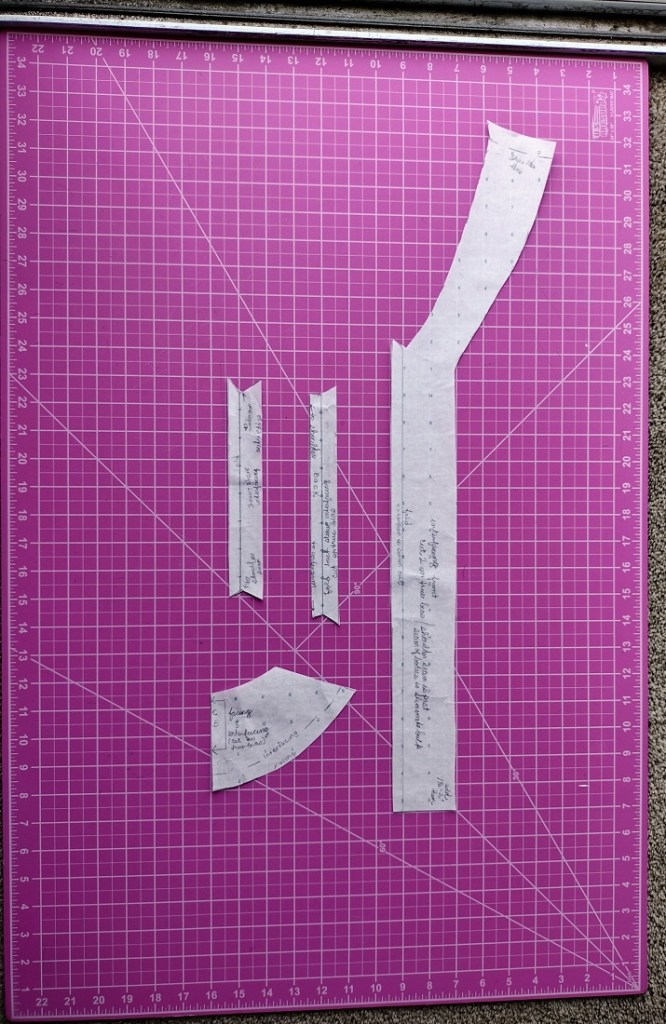
I took inspiration from two 1940s pattern envelope illustrations. The pattern was developed using a Misses Size 8 sloper developed through Precision Draping. Further draping was done on the basic blouse to develop the dolman sleeves.
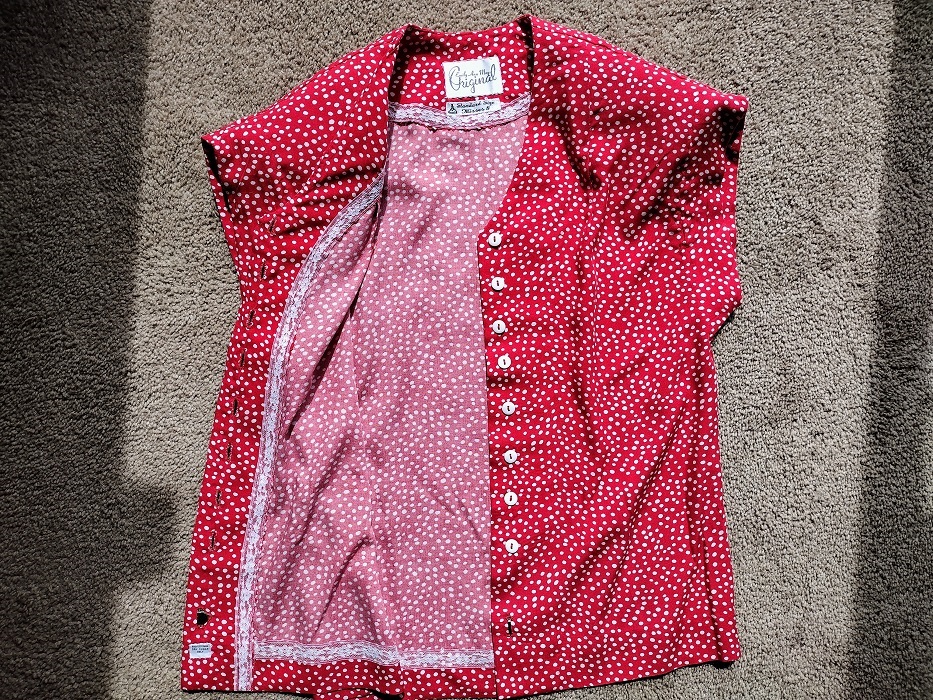
The blouse features a shoulder dart, short dolman sleeves and a round neckline. As I developed the pattern and tested the toile, I learned that I needed a shoulder pad to support the shape of the sleeve on the shoulder line. Omitting the shoulder pad caused the sleeve to droop and the entire blouse looked tired. My solution was to purchase very thin, regular set-in sleeve shoulder pads and use them for the blouse. I had to experiment with the placement until they looked just right. In the end, the shoulder pad extended about 1/4″ past the shoulder line. The shoulder pads are about 1/4″ thick.
I lowered the neckline of the blouse so I could wear a locket or chocker with the blouse if I wanted to. I selected a very silky, dotted print. To create some visual interest I used 1/2 wide white buttons sewn on with red thread. The contrast worked with the red background and the white dots on the fabric.
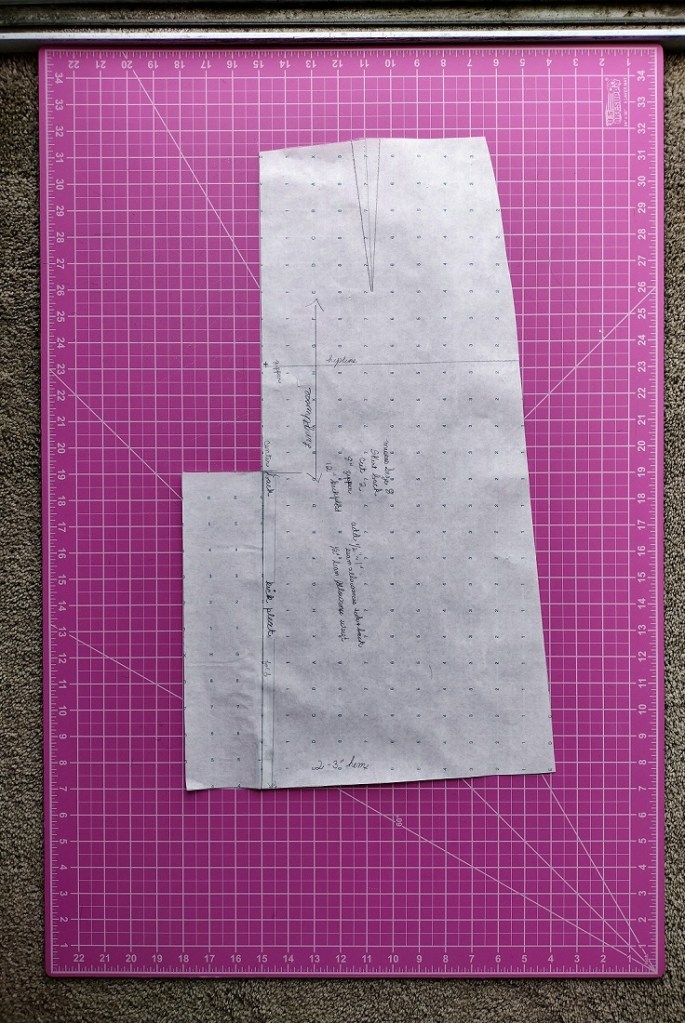
I think that 1940 walking skirts are much more figure flattering than pencil skirts. Most 1940s skirts curve over the hip and slightly extend out from there to the hemline. This is not the cookie-cutter A-Line skirt of the 1960s. This is more a slim skirt with a nice built in movement. The skirt moves very nicely when walking. I added kick pleats in front and back to get the most movement out of my skirt.
Fabrics, sewing and finishing details
The front facing of the blouse is in one with the blouse front. A separate facing piece is used for the back. The fabric is very slippery and needed gentle shaping for the neckline and blouse front. I cut the cotton batiste used for the interfacing on the true bias. This worked well with the fluid properties of the fabric. Seams were stitched together, pinked and then stitched again away from the edge. All seams were pressed to the back. Wrights Flexi-Lace was used to finish facing, sleeve hem and blouse hem. The entire facing was slant stitched by hand to the blouse using a fine hand sewing needle and small stitches that were not too tight.
The bias cut batiste interfacing has 1/2″ extra past center front. This creates a soft roll on the front of the blouse. The sleeve edges have a 3/8″ bias cut interfacing that extends past the hemline to create a soft fold when hemmed. The sleeves also are finished with Wrights Flexi-Lace.
The skirtis a lightweight blend that needed body to support the kick pleats. For this reason I choose to underline the skirt. Seams were pinked and straight stitched 1/8″ from the edge. The edges around each kick pleat and the hem are finished with Wrights Flexi-Lace. To add some visual interest I backed the kick pleat insert with the blouse fabric. On the back of the skirt I placed the size and designer labels on the kick pleat. The kick pleat is catched stitched to the underlining at the top.
The skirt has a side lapped zipper application that is hand stitched into place. The waistband uses Banroll to maintain the shape.
The dolman sleeve has a low armhole opening. This blouse is very comfortable but the bra shows just a little if the arm is raised. If this is a problem a camisole or slip can offer some more coverage. Personally this does not matter to me, as I do not think that many people are going to be looking under my arms and into my blouse.
Since the fabric was very slippery, easing the facing into the proper position created problems. I had to place the blouse inside out on the dress form. Then I pinned and basted the facing into place and after that the hem.
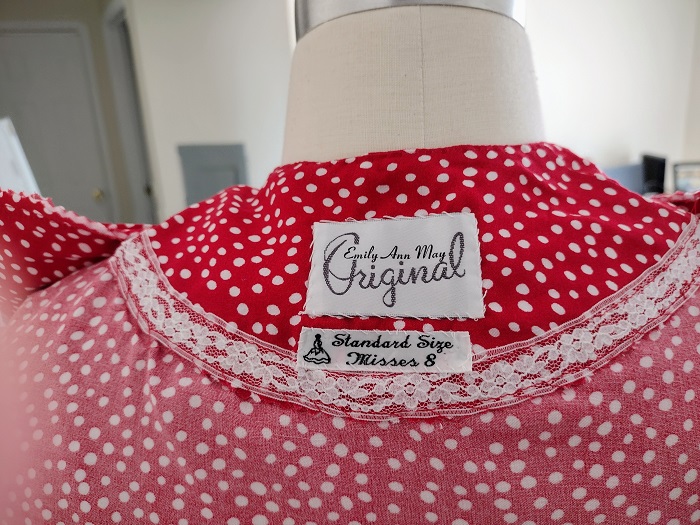
The finishing touch is a custom made label and size label. This always gives me a great sense of accomplishment. I recommend getting your own custom labels for your own creations.
Photos of me wearing the Linda skirt and blouse
Linda was a popular name for girls in the 1940s. I chose this name because it conveys a sense of the everyday which this outfit is meant to do. The emphasis is on fit and a flattering result. I am delighted with this vintage inspired outfit because it can work today and any day in any year.
The finished pattern diagram is available in this posting. It may be copied and sized in your graphics program. I release the pattern into the commons for anyone to use. Always test the pattern and make adjustments where needed.
It is possible to create a retro inspired look interpreted through your own style sensibility. You do not even need to have authentic vintage fashions and accessories to do this. What you do need is a sense of adventure and a keen eye. These can be applied when evaluating the clothes and accessories you already have or shop for. The goal is to get a sense of feeling and look from the vintage fashion. Then express in such a way that it’s a combo of something old and something new!
The Look I took inspiration from
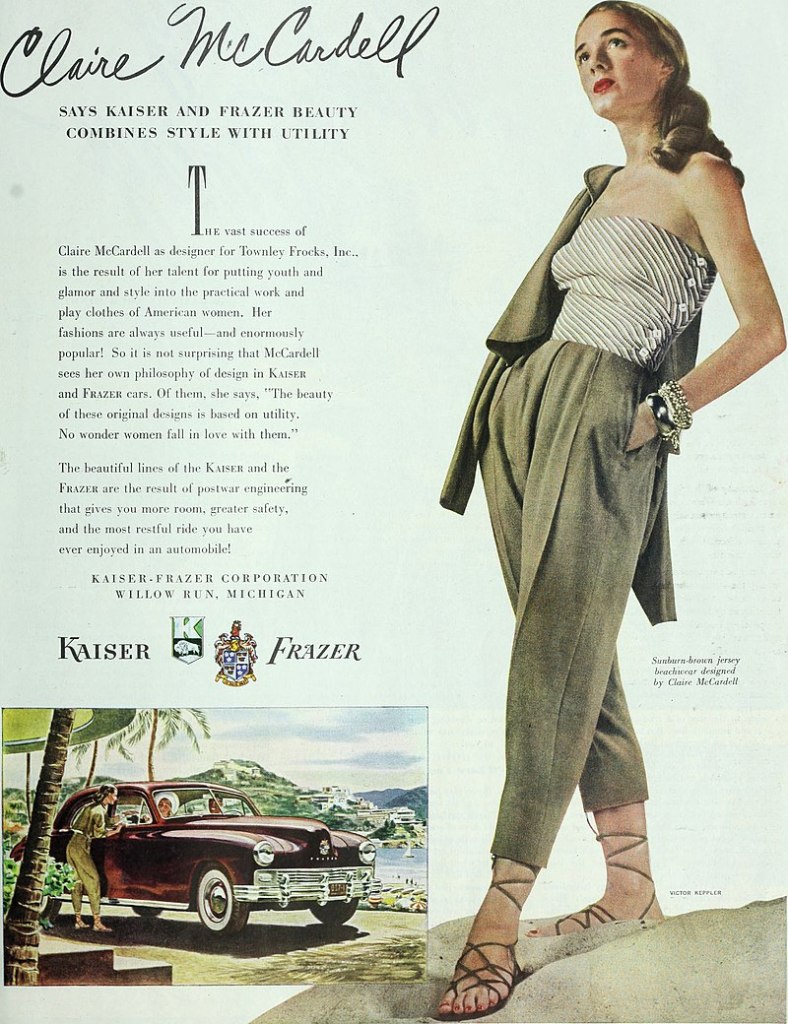
Claire McCardell was an American designer who had her peak popularity during the 1940s and 1950s. She designed comfortable fashions aimed at the American woman and her active lifestyle. Claire worked with knitwear as well as wovens. Her goal was to make elegance something that could be achieved in the simple pieces that make up a capsule wardrobe. She taught her followers how to do this in her book What shall I wear? By having comfortable, well fitting coordinates a woman was already on her way to elegant dressing every day of the week and any time of the day. Colors that worked well together and flattered the woman were important. Individual expression was achieved through beautiful accessories.
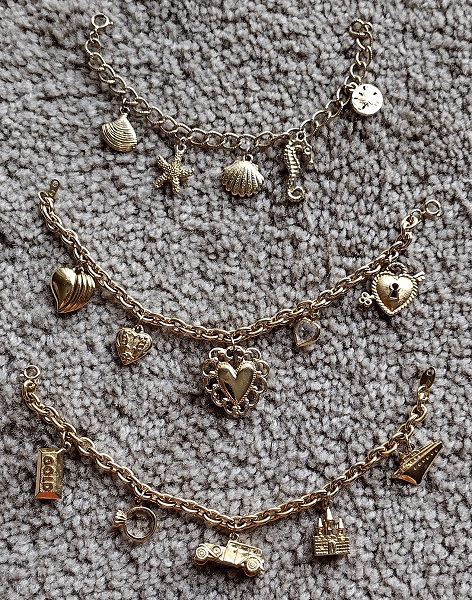
This photo comes from What shall I wear? I love the look of the chunky beaded necklace. And the multiple charm bracelets are enough to convey elegance and individuality.
The second outfit I took inspiration from is a trio of coordinates McCardell designed for beach wear. I especially like the slacks. The deep tucks at the waist and tapering legs of the slacks create a comfortable, easy garment flattering to a wide range of sizes. What I also love is the look of these slacks with the sandals.
With these inspirations in mind I set about recreating the look and making it my own.
How I expressed the look using modern clothing and accessories
I did not want a chunky beaded necklace. In the 1950s beading and sequins were very popular on cardigans and pullover sweaters. When I found this knitwear top it was perfect for starting the look. I also bought one in grey with silver beading.
I looked through the collection of costume jewlery my Mom left me and found the charm bracelets for the outfit.
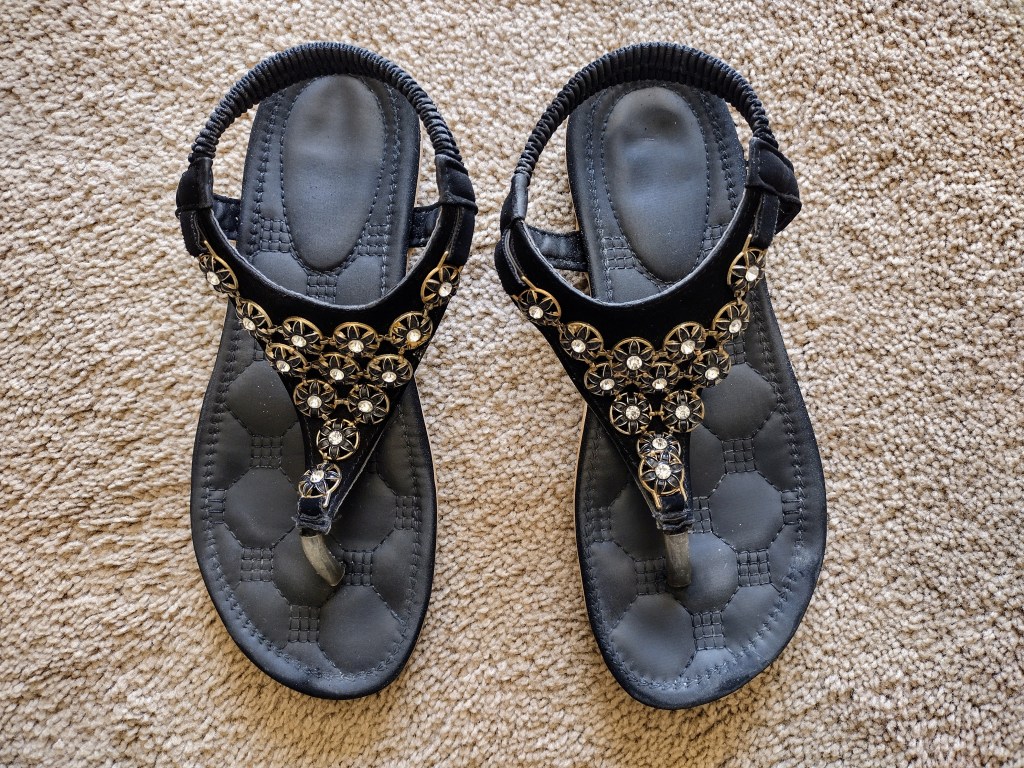
The next step was to find a comfortable pair of slacks that approximated the look of the ones I liked. I also had to find sandals that worked with the slacks.
I ended up at the bargain store where I’d bought the tops. I found two pairs of floral print slacks: one with pink blossoms and one with grey blossoms.
When I saw the sandals I knew I now had the right combination to channel the expression of my vintage inspired vibe.
Photo of the completed look
I am very pleased with the way this look came together. It expresses my own style yet has some of the elements of the original outfit. I hope you take some ideas from this to start your own creative style expression using vintage fashions as a starting point.
Credits
Close-up from What shall I wear? by Claire Mccardell

























 Pour Moi

You must be logged in to post a comment.