Styling with Intention: Katie’s Executive Look and the 60-30-10 Rule in Motion


🍂Introduction

As we transition into fall, our wardrobes naturally shift toward deeper hues and richer neutrals. The 60-30-10 rule—often used in interior design—offers a helpful framework for styling: 60% dominant color, 30% secondary, and 10% accent. But in legacy curation and intuitive dressing, this rule is best held gently. It’s a guide, not a grid. And when the pieces come together through thoughtful collection rather than fast shopping, the final look sings with harmony and soul.

Katie’s outfit, styled for an Executive Office setting, is a masterclass in intentional wardrobe curation. None of the pieces were purchased together, yet they speak fluently in the same visual language—one of quiet sophistication, subtle pattern play, and emotionally resonant accents.

🖤 The Foundation: 60% Black-Navy Hue

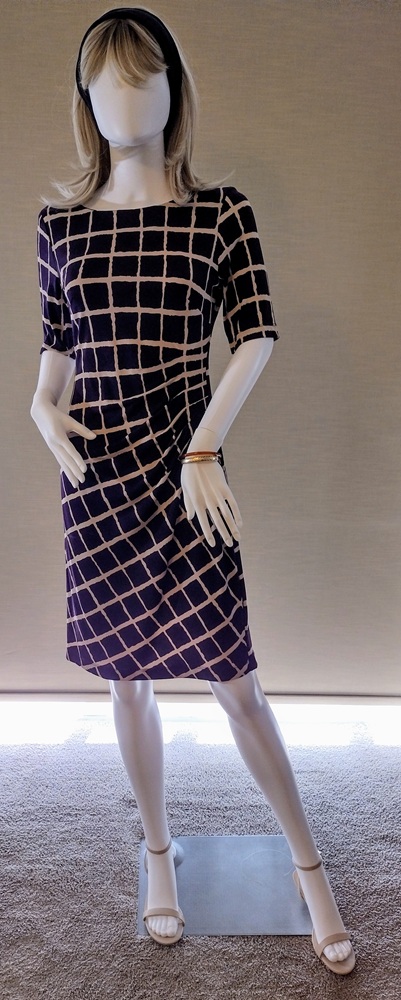
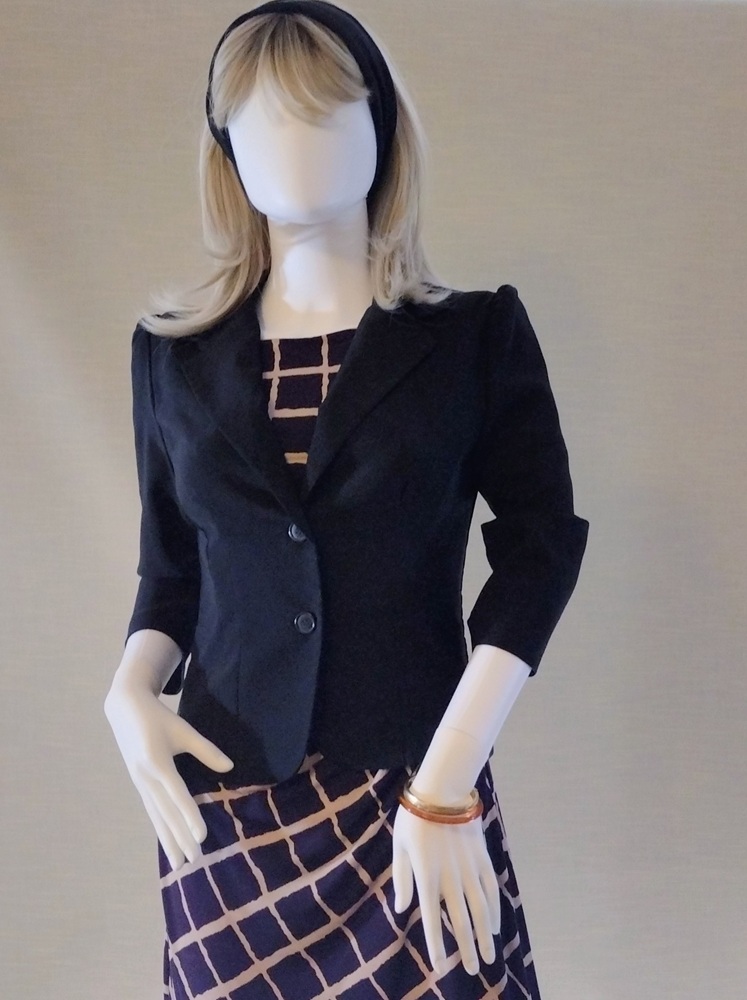
Katie’s dress is the anchor of the look—a pull-over poly knit that requires no zippers, buttons, or pressing. It’s effortless yet refined, shaped by dart tucks on the left side seam that release fullness past the bust apex. These tucks send the skirt on the bias, transforming the lattice print from evenly spaced squares above the waist to elegant diamond shapes below. The fabric’s black-with-a-whisper-of-navy tone forms the dominant color, grounding the ensemble in a deep, seasonally appropriate neutral.

🤎 The Complement: 30% Tan Lattice

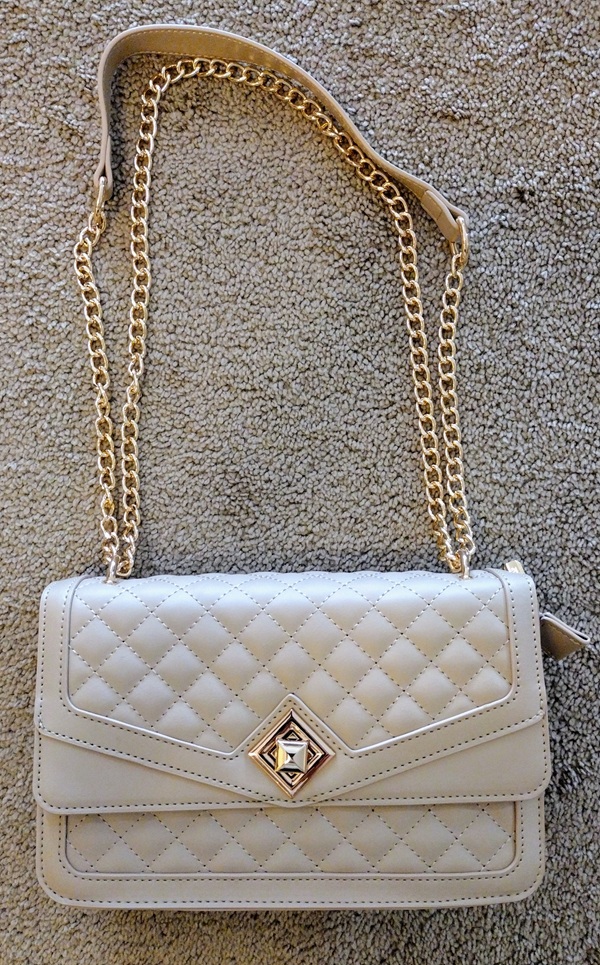
The tan lattice print is the secondary shade, adding warmth and visual interest. It’s not just a pattern—it’s a focal point. The geometric shift created by the bias cut adds movement and intrigue, making the dress feel both tailored and artistic. This tan tone is echoed in Katie’s quilted pocketbook and sandals—two pieces acquired at different times, yet perfectly matched in shade and spirit. The bag’s adjustable gold-tone chain and hardware elevate the look without overwhelming it.

✨ The Accent: 10% Gold and Amber

Accessories are minimal but meaningful. Katie wears two bracelets: a 14K gold bangle from my late mother, and a slim Russian amber bangle gifted by a cherished coworker. These pieces aren’t just adornments—they’re legacy touches, carrying emotional weight and subtle sparkle. They provide the perfect 10% contrast, adding warmth and depth to the darker palette.

🧥 The Layer: A Jacket with Quiet Authority

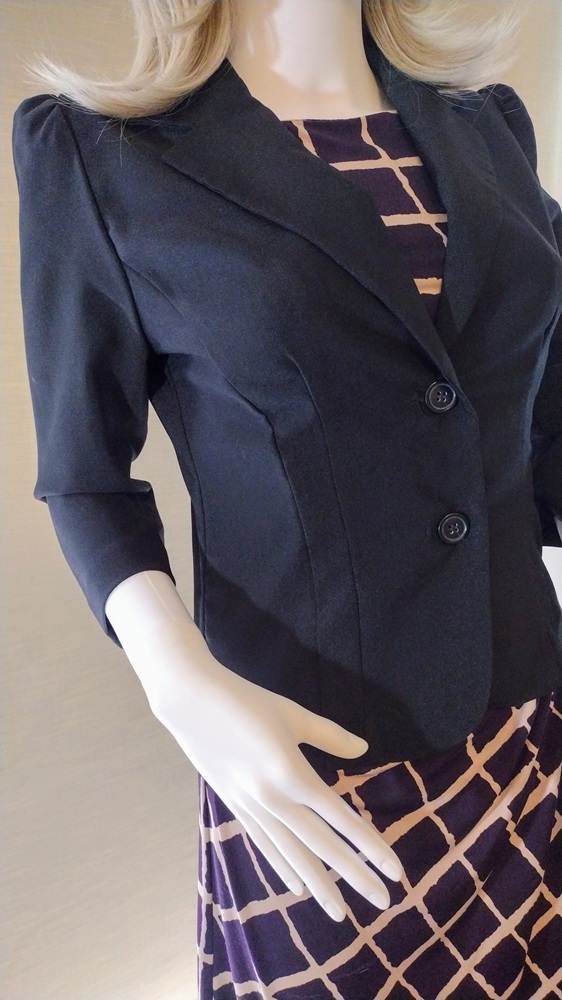
Over the dress, Katie wears a sculpted black jacket with a hint of navy. Though made from a different fabric than the dress, the dye lot differences are softened by the beige lattice print and the coordinating accessories. The jacket’s ¾ sleeves are gently gathered and puffed at the cap, offering structure without stiffness. It’s tailored yet comfortable—ideal for a professional setting where movement and presence matter.

The jacket achieves its flattering fit through thoughtful construction:

  • Princess seams run from the middle of the front armhole to the hemline, which stops at abdomen level.
  • A vertical dart in the side princess panel adds subtle shaping.
  • At the back, a center seam and vertical darts on either side contour the silhouette.
  • The wide lapel collar gives the illusion of shoulder pads, though the jacket is unlined, lightweight, and pad-free—proof that structure can be achieved without bulk.

🎀 The Finishing Touch

Katie completes her look with a simple black hairband—an understated detail that ties the ensemble together. And there she has it: an outfit created by shopping her closet, curated with care, and ready to take her from a day at the office to a casual dinner out.


🌿 Final Thoughts: Flexibility with Finesse

Katie’s look is a testament to the power of wardrobe curation. The 60-30-10 rule provided a starting point, but the final composition was guided by intuition, emotional resonance, and a deep understanding of color relationships. The result? A polished, professional outfit that feels cohesive, expressive, and entirely her own.

Whether you’re dressing for work, curating legacy offerings, or simply seeking harmony in your closet, let the rule guide you—but let your spirit lead.


Disclosure and Credits: This posting was researched and drafted by me. It was rewritten and condensed by Copilot for easier readability. All photos taken by me using the camera in my LG Android phone. Photos edited in the phone and in MS Paint.–EmilyAnn Frances May

Combining Minimalism and Vintage to Style a LBD

Introduction

For this styling exercise I wanted to apply the principles of Minumalism. Here are a few key elements of Minamulism in design and styling:

* Clothing is well fitting.
* Neutral shades predominate.
* Classic styling with minimal details.
* High quality fabrics and notions.
* Form follows function. There must be a purpose to every part of the garment. This results in fewer frills and non-essential details.
* Accessories must be carefully chosen and contribute to a refined look.

I started with my favorite Little Black Dress (LBD).

LBD Details

I bought this LBD at a small boutique on Fifth Avenue in Bay Ridge, Brooklyn. A sewista with mid-level skills will be able to analyze the style lines and understand how the fit is achieved. This LBD skims the body but is not form fitting. Fit is achieved through vertical princess seaming from shoulder to hem on each side of center front and center back. The princess seams intersect with the bust dart and vertical dart on the front of the basic sheath dress pattern. They also go through where the shoulder dart and vertical dart on the back basic pattern are.

There are two layers to the butterfly sleeves. Each layer is lined with a lightweight black satin. The dress is also lined with the same material. This helps the dress fit smoothly over the body. My challenge was to find one accessory that adds visual interest and works as a definitive focal point for the outfit. Determing the focal point is a skill developed through practice. My ability in this area is still developing.

The Focal Point for the LBD

I decided there could be two different focal points. Which one I would apply depended on the occassion.
Styling #1

The fluttery butterfly sleeves reminded me of similar sleeves on dresses and blouses of the 1930s. I wanted to add a combination of retro Art Deco and Modern Minimalism in the choice of the accessory to define the focal point.

I selected a wide elastic band belt with a triangular mock Marcasite belt. The sparkling belt buckle creates a striking contrast against the black dress. The width of the belt works well to create a more fitted look. The width of the belt is just right since it keeps the eye focused on the waist area. This is where I wanted the focal point to be.

Styling #2

For a different look, I removed the belt and considered accessories that create a different impact and vocal point. These accessories provide some interest but keep the eye focused on the fit and flow of the LBD. I chose costume jewelry in the form of a mock cubic zirconia ring set. The purse has a mock marcasite closure that also carries a little feeling of Art Deco. It may be used as a clutch. It also comes with silver chains with clasps that connect with loops that swivel up from the inside of the purse. For a little added sophistication, a silvery rhinestone perfume atomizer or lipstick case can add further interest to the purse as a focal point.

Conclusion

It is possible to combine the principles of timelessness and simplicity of Minimalism with one or two elements of vintage fashion. Practice and experimentation will help develop the sensibilities needed.

1930s Skirt and Blouse: Finding the Focal Point

Introduction

This week I reviewed the first sketch made for my next project, a 1930s inspired skirt and blouse. I do not have much experience working with styles of this decade, so it is a big challenge for me. I have only made one dress using design elements from a 1930s book, Paris Frocks at Home. That dress was designed as what I envisioned a woman would have as a special occasion dress during the Great Depression. It was pretty enough for a semi-formal occasion and yet could be worn for more everyday events such as a Sunday visit.

With my new project I am envisioning how a woman would dress for work during the 1930s. I want the skirt and blouse to be pretty and attractive enough to be wearable for today. For this reason I am taking only certain elements from the 1930s, not all of them.

I re-thought the first sketch and was not satisfied with it. I will detail the reasons here while sharing the importance of maintaining a clear focal point for any design.

What is a focal point?

A focal point is that part of the outfit where you want to:

–direct the gaze of the viewer
–emphasize a feature and make it attractive
–express an idea about the outfit, i.e. what is the message

Importance of integrating a focal point into the flow of the design

A focal point must be in harmony with the overall appearance and purpose of the outfit. It has to have pleasing proportions and add to the wearers attractiveness. Learning how to balance focal points takes experience. You want at least one, perhaps two. But never so many that the eye does not rest on any particular area and then move to what feature you are emphasizing. For example, in Version 1 of the 1930s outfit there are, I think, conflicting focal points. The scalloped yoke of the skirt competes with the bow of the blouse.

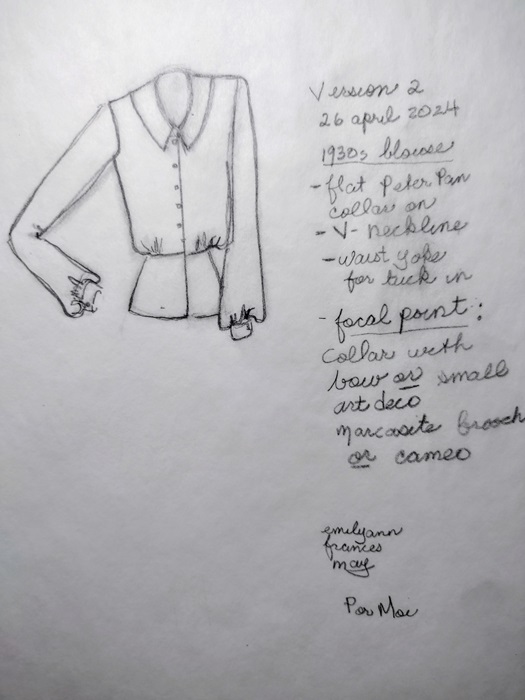
Version no. 2 of the skirt and blouse appears more calm and pleasing to the eye. The flounce at the bottom of the skirt emphasizes the movement when the wearer walks. A second focal point is the v-neckline of the Peter Pan flat collar. A small, marcasite Art Deco broach can be pinned at the neckline to create a second focal point. Or, very pretty but small buttons may be used to create the second focal point. Here there is a more sublte play between the focal points that Version no. 1 lacks.

How to compare focal points and choose the right combinations

One way to choose the right combination of focal points, or choose to have just one focal point, is to make separate sketches of the parts of the outfit. Then make a complete sketch of the outfit put together.

1930s skirt and blouse sketches and notes, Version no. 1

1930s skirt and blouse sketches and notes, Version no. 2.

If doubts remain about the current pairing of separate parts of the outfit, the sketches of the garment pieces can be mixed and matched. This gives some idea on how the elements might or might not work together in a different combination.

Blouse Ver. no. 2 is paired with Skirt Ver. no. 1 on the left. On the right Blouse Ver. no 1 is paired with Skirt Ver. no. 2.

It helps if the sketches are put aside for a day or two. Then they can be reviewed again with a fresh point of view. When performing this review, be aware of what first captures your attention. Then consider how that first focal point works with other elements in the design.

Through this process of sketching, considering, studying and planning you will come up with an important and clear definition of how to proceed in the next steps of your design plans.

My final choice: Version no. 2

Additional Resources

To learn more about focal points in fashion please visit:

UEN Utah Education Network
Emphasis_the_Focal_Point_of_Fashion_1_.pdf
Scroll down and on the right side of the screen are free course materials you can download that will help you understand what the focal point is about.

Purfe: Fashion, design and perfect fit
“Basic Principles of an Outfit Layout: Focal Point”
October 14, 2012
by Olga