1930s Skirt and Blouse: Finding the Focal Point

Introduction

This week I reviewed the first sketch made for my next project, a 1930s inspired skirt and blouse. I do not have much experience working with styles of this decade, so it is a big challenge for me. I have only made one dress using design elements from a 1930s book, Paris Frocks at Home. That dress was designed as what I envisioned a woman would have as a special occasion dress during the Great Depression. It was pretty enough for a semi-formal occasion and yet could be worn for more everyday events such as a Sunday visit.

With my new project I am envisioning how a woman would dress for work during the 1930s. I want the skirt and blouse to be pretty and attractive enough to be wearable for today. For this reason I am taking only certain elements from the 1930s, not all of them.

I re-thought the first sketch and was not satisfied with it. I will detail the reasons here while sharing the importance of maintaining a clear focal point for any design.

What is a focal point?

A focal point is that part of the outfit where you want to:

–direct the gaze of the viewer
–emphasize a feature and make it attractive
–express an idea about the outfit, i.e. what is the message

Importance of integrating a focal point into the flow of the design

A focal point must be in harmony with the overall appearance and purpose of the outfit. It has to have pleasing proportions and add to the wearers attractiveness. Learning how to balance focal points takes experience. You want at least one, perhaps two. But never so many that the eye does not rest on any particular area and then move to what feature you are emphasizing. For example, in Version 1 of the 1930s outfit there are, I think, conflicting focal points. The scalloped yoke of the skirt competes with the bow of the blouse.

Version no. 2 of the skirt and blouse appears more calm and pleasing to the eye. The flounce at the bottom of the skirt emphasizes the movement when the wearer walks. A second focal point is the v-neckline of the Peter Pan flat collar. A small, marcasite Art Deco broach can be pinned at the neckline to create a second focal point. Or, very pretty but small buttons may be used to create the second focal point. Here there is a more sublte play between the focal points that Version no. 1 lacks.

How to compare focal points and choose the right combinations

One way to choose the right combination of focal points, or choose to have just one focal point, is to make separate sketches of the parts of the outfit. Then make a complete sketch of the outfit put together.

1930s skirt and blouse sketches and notes, Version no. 1
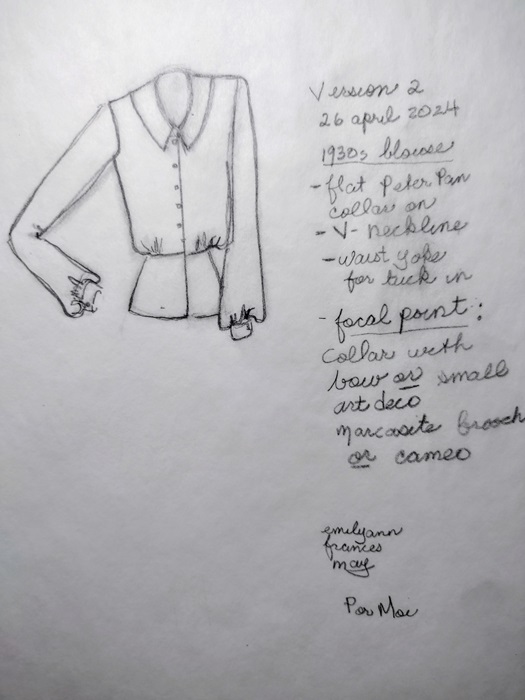
1930s skirt and blouse sketches and notes, Version no. 2.

If doubts remain about the current pairing of separate parts of the outfit, the sketches of the garment pieces can be mixed and matched. This gives some idea on how the elements might or might not work together in a different combination.

Blouse Ver. no. 2 is paired with Skirt Ver. no. 1 on the left. On the right Blouse Ver. no 1 is paired with Skirt Ver. no. 2.

It helps if the sketches are put aside for a day or two. Then they can be reviewed again with a fresh point of view. When performing this review, be aware of what first captures your attention. Then consider how that first focal point works with other elements in the design.

Through this process of sketching, considering, studying and planning you will come up with an important and clear definition of how to proceed in the next steps of your design plans.

My final choice: Version no. 2

Additional Resources

To learn more about focal points in fashion please visit:

UEN Utah Education Network
Emphasis_the_Focal_Point_of_Fashion_1_.pdf
Scroll down and on the right side of the screen are free course materials you can download that will help you understand what the focal point is about.

Purfe: Fashion, design and perfect fit
“Basic Principles of an Outfit Layout: Focal Point”
October 14, 2012
by Olga

RetroGlam holiday weekend dress-up fun

Since this is the Labor Day weekend in the U.S., I have more time for dressing up in vintage clothes and sharing online. I also dressed my vintage fashion dolls up. Here are photos from this special day and my trip back in time to the time when my Mom and Aunties lived. Yes, they wore pretty housedresses like the ones by Pat Perkins. For very special occasions they had a sheath dress in a print or basic black. Other popular styles for day into evening had fitted bodices with scoop necklines, fitted sleeves and flared skirts.

1950s Pat Perkins day dress/house dress

This black and white checked dress is by Pat Perkins. The seller on ebay estimated it was early to mid 1950s. I agree with that because there is a side zipper. The bodice opens part way under the Princess Panel on the left so that the dress is easier to put on.

I plan to take detailed photos of this dress and will share a style and construction analysis. My next project will be based on this dress. I will use the new sloper I am developing for 1950s inspired outfits once it is finished.

1950s cocktail/evening dress-unknown dressmaker-custom sized

I bought this vintage dress on Ebay during Lockdown 2020. The seller described the dress as custom made around the 1950s. It is about one size too big for me, but still I enjoy dressing up in it and taking photos in it. I am not sure if this is considered a cocktail dress, an evening dress or a day-to-evening dress. Sometimes the subtler categories for when women wore what kind of clothing in decades prior to the 1970s pass me by.

This dress is exquisitely made. It is fully lined in a matching mandarin orange colored silky fabric. Both the fabric and the lining are either 100% synthetic or a blend. The brocade of the dress is soft and very comfortable to wear. The sleeves are short mounted sleeves with a gusset under the arm. I think in the U.K. the term is “grown-on sleeve”. The dress closes with a center back slot zipper. There are many other finishing and construction details I will share in the future.

When you see a vintage garment you are interested in for study and/or wear, buy it if you can afford it. Once you own it you have a piece of fashion history. You also have a study piece that will expand your knowledge first hand of how clothing was constructed in the past.

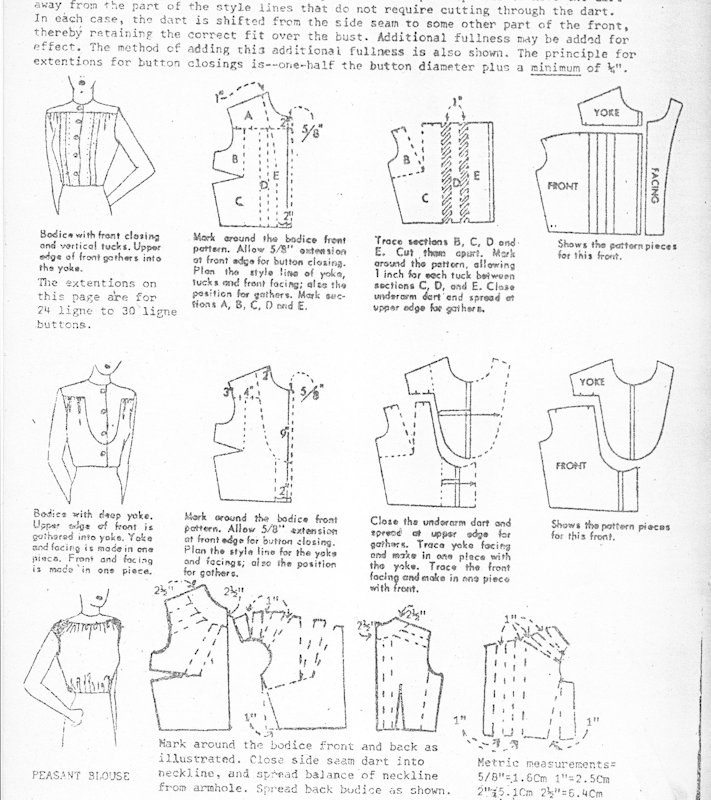
Style lines from a vintage patternmaking handout

In my previous posting, “What are style lines?” I explained what style lines are. I showed how a few style lines can be used to transform a basic skirt and bodice into a vintage inspired fashion from a 1964 magazine photograph.

Today, I’m sharing classroom handouts from a vintage patternmaking book. The style lines used are easy to understand and clearly illustrated on the basic bodice. Based on my knowledge of patternmaking it looks like the “slash and spread” method was used. This means, the pattern was created by tracing the basic sloper. The style lines were then drawn. After that, the pattern was slashed and spread when tucks or gathers had to be created. Other patterns were simply cut along the style lines, like the one for the princess line bodice.

I estimate that these pattern transformations are from the 1940s.

Styling Adventure: Taking inspiration from a retro look

Introduction

It is possible to create a retro inspired look interpreted through your own style sensibility. You do not even need to have authentic vintage fashions and accessories to do this. What you do need is a sense of adventure and a keen eye. These can be applied when evaluating the clothes and accessories you already have or shop for. The goal is to get a sense of feeling and look from the vintage fashion. Then express in such a way that it’s a combo of something old and something new!

The Look I took inspiration from

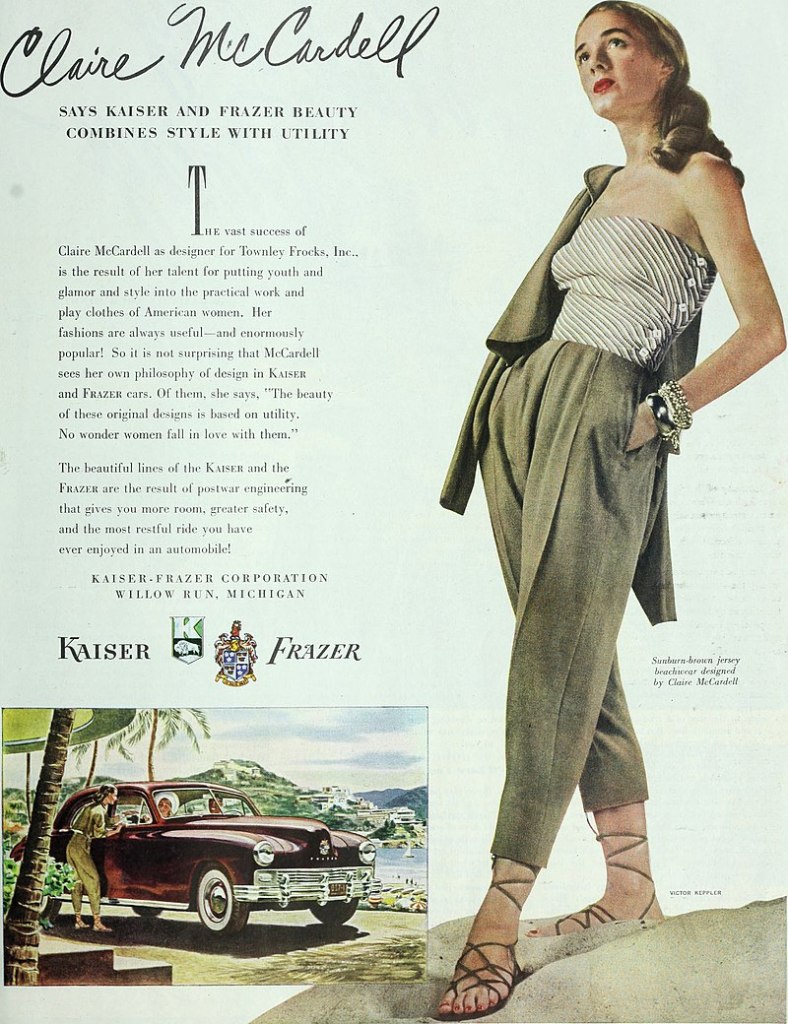
Claire McCardell was an American designer who had her peak popularity during the 1940s and 1950s. She designed comfortable fashions aimed at the American woman and her active lifestyle. Claire worked with knitwear as well as wovens. Her goal was to make elegance something that could be achieved in the simple pieces that make up a capsule wardrobe. She taught her followers how to do this in her book What shall I wear? By having comfortable, well fitting coordinates a woman was already on her way to elegant dressing every day of the week and any time of the day. Colors that worked well together and flattered the woman were important. Individual expression was achieved through beautiful accessories.

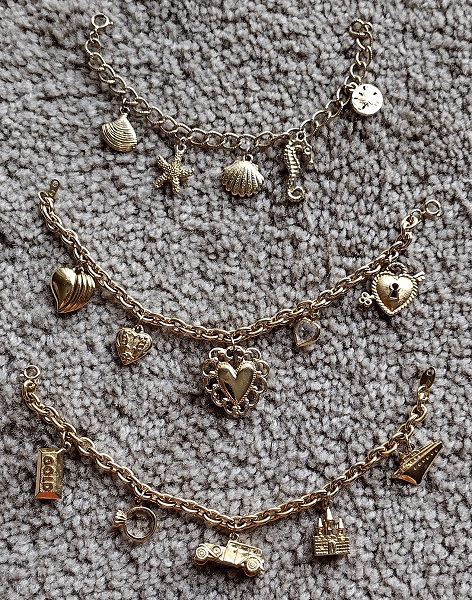
This photo comes from What shall I wear? I love the look of the chunky beaded necklace. And the multiple charm bracelets are enough to convey elegance and individuality.

The second outfit I took inspiration from is a trio of coordinates McCardell designed for beach wear. I especially like the slacks. The deep tucks at the waist and tapering legs of the slacks create a comfortable, easy garment flattering to a wide range of sizes. What I also love is the look of these slacks with the sandals.

With these inspirations in mind I set about recreating the look and making it my own.

How I expressed the look using modern clothing and accessories

I did not want a chunky beaded necklace. In the 1950s beading and sequins were very popular on cardigans and pullover sweaters. When I found this knitwear top it was perfect for starting the look. I also bought one in grey with silver beading.

I looked through the collection of costume jewlery my Mom left me and found the charm bracelets for the outfit.

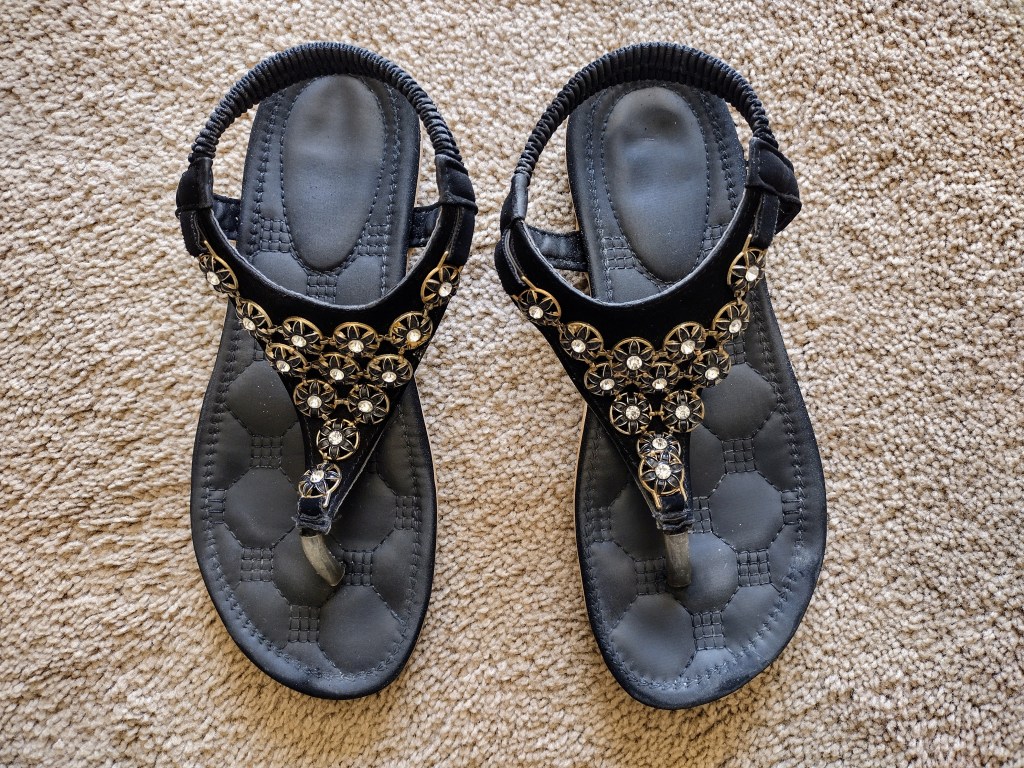
The next step was to find a comfortable pair of slacks that approximated the look of the ones I liked. I also had to find sandals that worked with the slacks.

I ended up at the bargain store where I’d bought the tops. I found two pairs of floral print slacks: one with pink blossoms and one with grey blossoms.

When I saw the sandals I knew I now had the right combination to channel the expression of my vintage inspired vibe.

Photo of the completed look

I am very pleased with the way this look came together. It expresses my own style yet has some of the elements of the original outfit. I hope you take some ideas from this to start your own creative style expression using vintage fashions as a starting point.

Credits

Close-up from What shall I wear? by Claire Mccardell

Full length photo: Claire McCardell Beach Outfit
Public domain-WikimediaCommons
https://commons.wikimedia.org/wiki/File:Sunburn-brown_jersey_beachware_designed_by_Claire_McCardell.jpg