
Introduction
I am preparing two slopers this summer. I already created one that I use for 1940s to early 1950s inspired styles. I used that for the Alice Elizabeth dress and the Linda skirt and blouse. I am now in the progress of creating a more structured sloper that I think will work well with the more detailed and fitted styles of the mid-1950s. As a challenge and contrast, I am also researching slopers from the 1930s. The look of the 1930s was very flowing and not fitted the way 1950s clothing was.
My 1940s sloper is available for copying and sizing here. It is a standard Misses 8. The sloper for the 1950s structured fashions is also in a size 8. However, I think the 1930s look is very flattering to smaller sizes so that sloper will be in a standard Misses 4. I do not intend to use drafting systems from the 1930s. Instead, I will drape a basic unfitted bodice and skirt that approximate the look of a set of pattern blocks I located in a small paperback book called Dress Cutting by Margaret C. Ralston. I will draft a fitted sleeve with vertical dart to complete the sloper.
Here are the screen shots showing the basic block Margaret created from her drafting system. I find it a bit confusing to follow. I am also not sure the fit will be comfortable for the modern women. The sleeve looks very fitted and the sleeve seam is 3/4″ to the front of the bodice side seam. While I love vintage styles I do not think it is essential to go so far to recreate or be inspired by the look. The key for me is inspired interpretation.
Pattern Block from Dress Cutting by Margaret Ralston
The bodice front and back appear to be completely unfitted. In some directions for pattern transformations one dart above the bodice is shown. It might also be a tuck. I assume the bodice block had enough width for this dart-tuck to be created.
The skirt is a rectangle equal to half the hip circumference. It is then slashed and overlapped and the top edge so that the waistline measurement results. I plan to drape a basic sheath skirt. Once that fits, I will distribute the dart ease across skirt front and back waistline. Then slightly overlap the sections. That will produce a slightly flared, straight skirt which is the starting point for the skirt styles in this book. For the bodice I will drape an unfitted bodice. It will go straight to the hip and have the waistline marked off as well. There will be one vertical dart above the bust in front and a neckline dart or two in the back. I’m basing the dart positions on the fitting dress or toile shown in the previous posting.
I think developing different bodice and skirt slopers gives one a more extensive collection of shapes to work from. As I research the 1930s, I’m understanding that for the 1960s an unfitted dress sloper works well. So would an A-Line skirt sloper. Those are the two key shapes for dresses and skirts of the 1960s.
Here are the snap shots of the pattern blocks from Dress Cutting. The last snap shot is a dress that can be made using he pattern blocks and transformation instructions in the book.

Cover of Dress Cutting by Margaret Ralston.
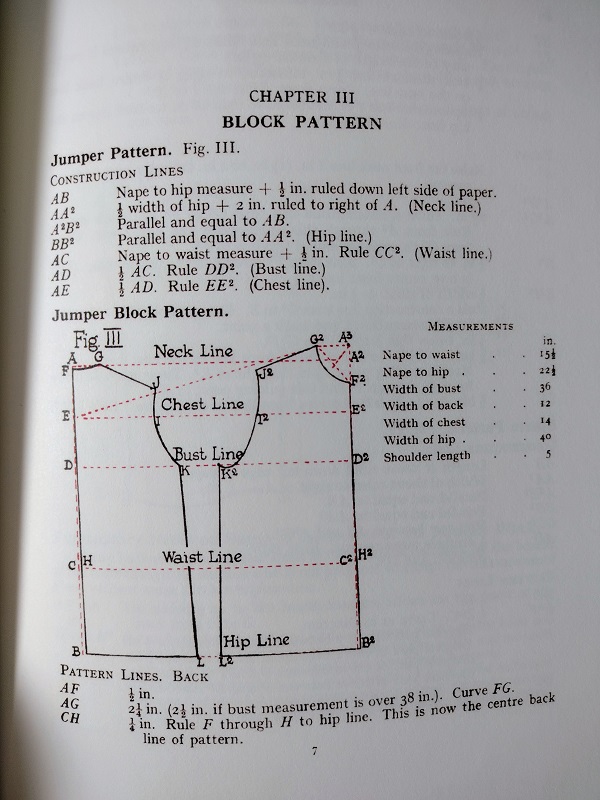
Bodice front and back.
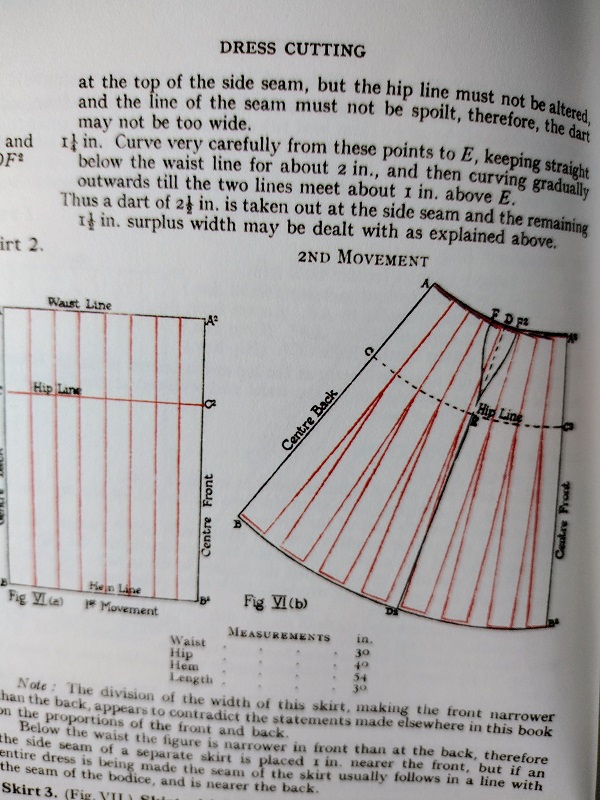
Basic skirt front and back.

Basic sleeve.

Fitted sleeves.

One of the styles that can be created using the block and instructions in Dress Cutting by Margaret Ralston.
 Pour Moi
One thought on “Researching and preparing a 1930s inspired pattern sloper”
Comments are closed.