Building an Outfit Around a Focal Point: Let One Special Piece Lead the Way

Introduction

A well‑chosen focal point gives an outfit unity and intention. The eye naturally travels to the element you want to highlight, so it’s worth considering what you emphasize and why. When you choose pieces that enhance your best features and support your focal point, your outfit feels harmonious from the start. This is especially helpful when shopping for new wardrobe additions. In this post, I’ll show you how I selected three pieces — each from a different manufacturer — and coordinated them into a unified look by focusing on color and a clear focal point.


Beginning: A Rhinestone‑and‑Pearl T‑Shirt With the Word STYLE
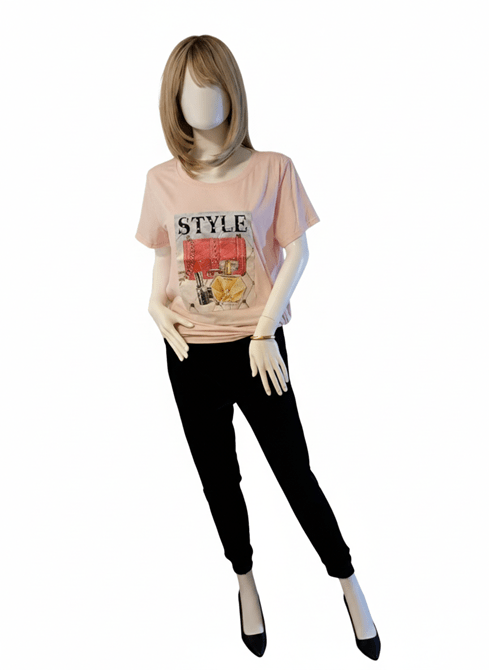
A cheerful spring‑ready look built around one uplifting focal poiny.

This pink t‑shirt immediately felt like Spring to me — soft, cheerful, and perfect for that in‑between season when we’re longing for sunshine, warmth, and the first fragrance of flowers. The cut is loose and not particularly flattering on its own, but the decorative panel on the front makes it special. The word STYLE is embellished with pearls, and the illustrated cosmetics below it sparkle with rhinestones. The panel’s deeper pink background adds dimension and contrast. I knew right away this was the uplifting piece I needed to bridge the time between February and April.
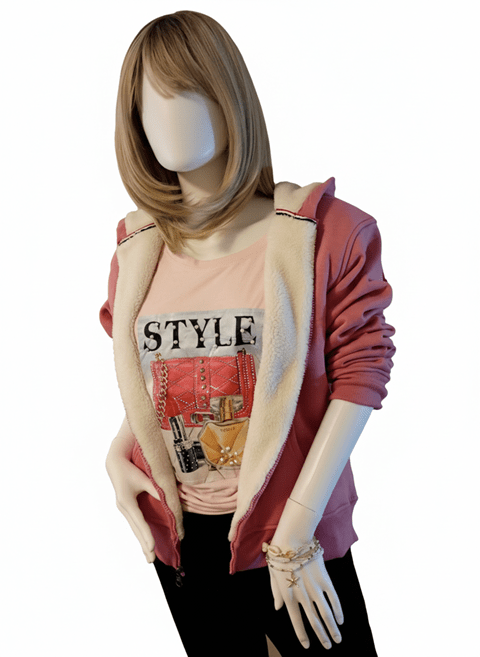
Layering soft pinks creates warmth and harmony, especially when textures play together.

My next step was choosing colors to complement the t‑shirt. I took my cue from the illustration: a dark navy lipstick tube stood out to me. With that in mind, I browsed the racks and found a pair of dark navy plus‑velvet sports slacks. They’re slim‑fitting with ankle cuffs, and the rich texture contrasts beautifully with the smooth t‑shirt. I planned to wear black pumps with this outfit — the black echoes the lettering on the shirt and keeps the attention where it belongs, without competing with the focal point.
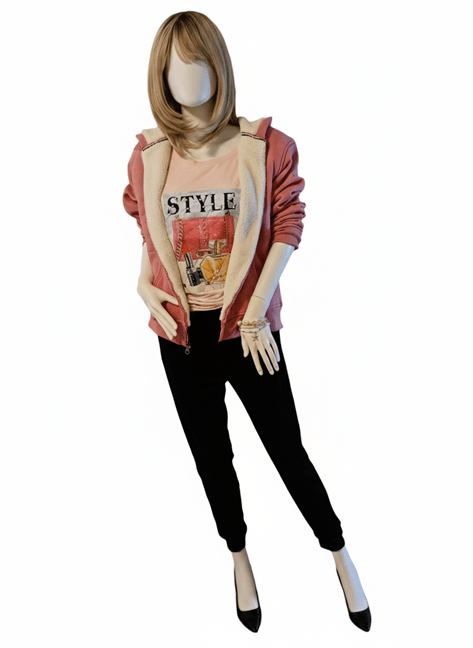
The finished outfit: coordinated colors, mixed textures, and a focal point that shines.

The final clothing piece was a sweater or hoodie. I chose a fleece‑lined hoodie in a deeper pink. Its shade is close enough to the darker pink in the t‑shirt’s panel to feel related, especially when paired with the white fleece lining. Whether worn open or slightly zipped, the lining softens the transition between the two pinks and helps the eye read them as a coordinated pair.

To finish the look, I gathered the t‑shirt at the side and tied a small knot. This adds shape, keeps the hem neat, and supports the overall silhouette. For accessories, I kept things simple. When wearing just the slacks and t‑shirt, a gold bangle complements the golden perfume bottle on the decorative panel. When the hoodie is added, stretch bracelets with white and gold beads tie in beautifully with the panel’s details and the hoodie’s lining.


Conclusion

By keeping the focal point in mind, I had a clear guide while shopping. The result is a coordinated outfit with room to grow as I add more tops or bottoms in similar tones and textures. The lesson here is that you don’t always need a plan before you shop. Start with the one striking piece that catches your eye. Then let color, texture, and your chosen focal point lead the way. From there, the outfit will naturally take shape.

Thank you for spending this styling moment with me — may your next “just‑because” purchase spark a little joy and guide you toward an outfit that feels beautifully, confidently you.

Style Tip: Let Your Focal Point Do the Talking

  • Start with one striking piece that lifts your mood.
  • Pull supporting colors from the details — even tiny ones count.
  • Mix textures to add richness without overwhelming the eye.
  • Keep accessories simple so your focal point stays center stage.
  • When in doubt, trust your instincts; harmony often begins with the piece you love most.

Disclosures

This post was drafted by me.
I collaborated with Microsoft Copilot to refine the text and tighten narrative flow.
I took the photos using the camera in my Cricket LG Phone.
Gemini and Nano Banana, accessed through Google Search, edited the photos by removing the backgrounds.

Combining Minimalism and Vintage to Style a LBD

Introduction

For this styling exercise I wanted to apply the principles of Minumalism. Here are a few key elements of Minamulism in design and styling:

* Clothing is well fitting.
* Neutral shades predominate.
* Classic styling with minimal details.
* High quality fabrics and notions.
* Form follows function. There must be a purpose to every part of the garment. This results in fewer frills and non-essential details.
* Accessories must be carefully chosen and contribute to a refined look.

I started with my favorite Little Black Dress (LBD).

LBD Details

I bought this LBD at a small boutique on Fifth Avenue in Bay Ridge, Brooklyn. A sewista with mid-level skills will be able to analyze the style lines and understand how the fit is achieved. This LBD skims the body but is not form fitting. Fit is achieved through vertical princess seaming from shoulder to hem on each side of center front and center back. The princess seams intersect with the bust dart and vertical dart on the front of the basic sheath dress pattern. They also go through where the shoulder dart and vertical dart on the back basic pattern are.

There are two layers to the butterfly sleeves. Each layer is lined with a lightweight black satin. The dress is also lined with the same material. This helps the dress fit smoothly over the body. My challenge was to find one accessory that adds visual interest and works as a definitive focal point for the outfit. Determing the focal point is a skill developed through practice. My ability in this area is still developing.

The Focal Point for the LBD

I decided there could be two different focal points. Which one I would apply depended on the occassion.
Styling #1

The fluttery butterfly sleeves reminded me of similar sleeves on dresses and blouses of the 1930s. I wanted to add a combination of retro Art Deco and Modern Minimalism in the choice of the accessory to define the focal point.

I selected a wide elastic band belt with a triangular mock Marcasite belt. The sparkling belt buckle creates a striking contrast against the black dress. The width of the belt works well to create a more fitted look. The width of the belt is just right since it keeps the eye focused on the waist area. This is where I wanted the focal point to be.

Styling #2

For a different look, I removed the belt and considered accessories that create a different impact and vocal point. These accessories provide some interest but keep the eye focused on the fit and flow of the LBD. I chose costume jewelry in the form of a mock cubic zirconia ring set. The purse has a mock marcasite closure that also carries a little feeling of Art Deco. It may be used as a clutch. It also comes with silver chains with clasps that connect with loops that swivel up from the inside of the purse. For a little added sophistication, a silvery rhinestone perfume atomizer or lipstick case can add further interest to the purse as a focal point.

Conclusion

It is possible to combine the principles of timelessness and simplicity of Minimalism with one or two elements of vintage fashion. Practice and experimentation will help develop the sensibilities needed.

The Value of Styling and Visual Merchandising for Dressmakers

Have you ever wondered how you can sharpen your style sense and design vision? Developing your style sense is a path of continual improvement. How does a sewist or sewista practice color coordination and accessorizing? I asked myself these questions a few months ago. This is why I bought a mannequin. I named her Katie and she serves as a model and advisor. It is one thing to envision an outfit I will make or coordinate from clothing I purchased. It is another experience to see that outfit on a mannequin.

A mannequin can be another you, your muse or the customer you target for your creations. The mannequin enables you to step back and behold the impact of the outfit. In this sense, you can experience the outfit and the impression it makes. This experience takes place in real time, whenever you walk into the room and see the mannequin. It is more immediate and vivid that reviewing selfies, or photos others have taken of you in the outfit. The mannequin lets you experience the outfit in real time.

I am styling outfits for Katie from the clothing I already have. For this posting I created a casual back-to-the office look using separates. I did not buy any of the pieces at the same time. My preference for certain colors made the coordination of this outfit possible. Choosing a basic black mini-skirt and pumps also made the outfit come together. I would recommend a similar approach if you decide to start styling outfits on a mannequin. Choose one piece in black, white, navy blue, grey, or brown. Then pair it with a piece in a complementary color or print.

Sharing photos of your styled look will help you get feedback.. There is an excitement to discussing a new outfit and consulting with others what will round it out. In the process you will be interacting with others in a way that design team members do. Everyone will see the outfit in a different way. Some will suggest you add an element, and some may critique it. It is important to accept the feedback with grace and use it as a means to grow your style sense and design skills.